Why tea belongs to the highland landscape
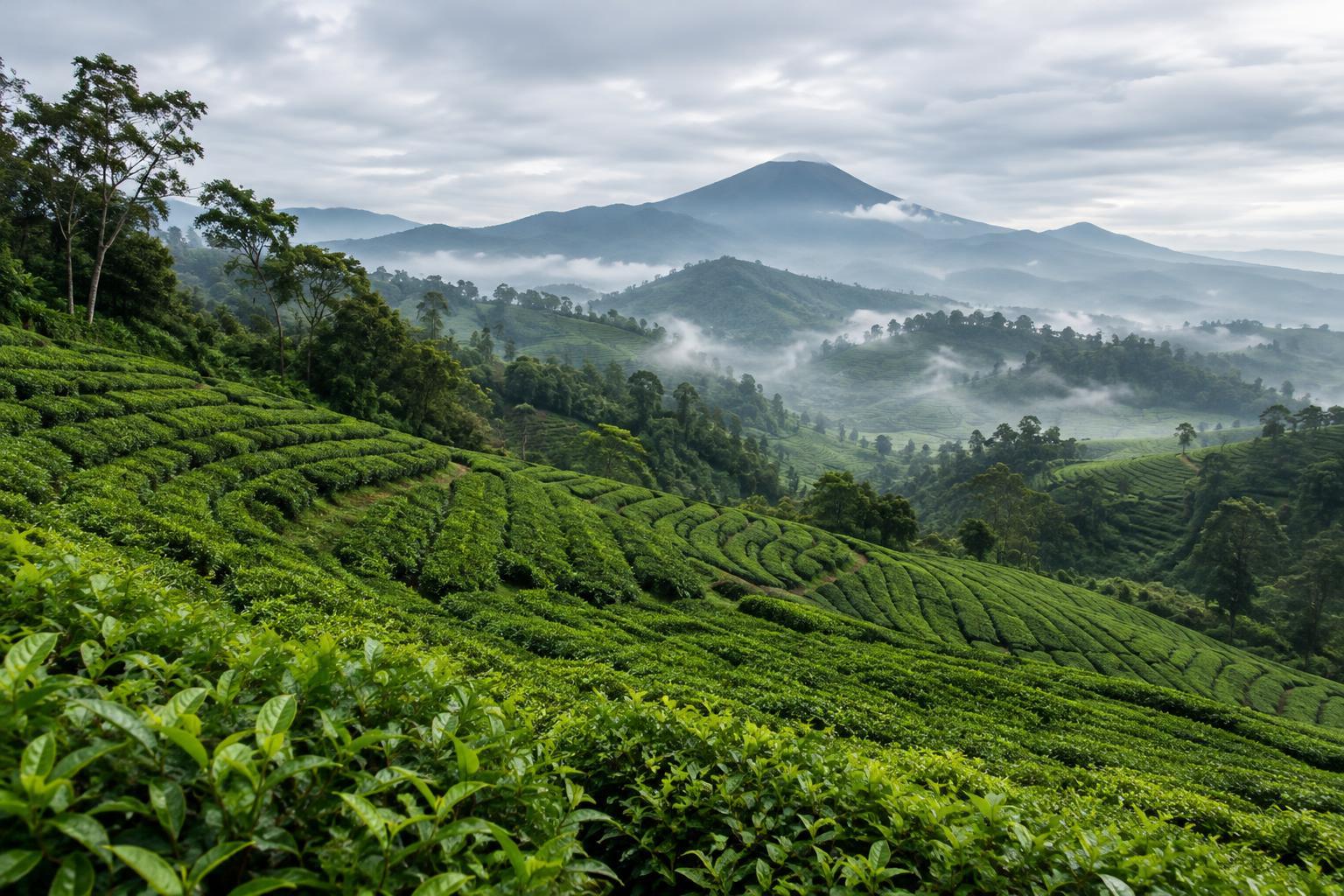
Travel through parts of West Java’s uplands and tea can seem to cover entire hillsides. Its low, closely trimmed bushes form sweeping bands of green, interrupted by paths, taller trees and the occasional building. The pattern is striking, but it is not a natural meadow. A tea estate is a cultivated landscape, shaped by repeated harvesting and upkeep as well as by the contours of the land beneath it.
Tea grows in several parts of Java, and West Java’s tea areas are not all alike. Around the Bandung highlands and the hills near Puncak, for example, the setting may shift within a short journey from dense settlement to garden plots, forest patches and broad tea fields. Looking beyond the familiar green rows reveals a more varied landscape, where agriculture, water, roads and communities occupy the same slopes.
What elevation changes
Climbing into the highlands usually brings cooler air than travelers encounter in West Java’s lower-lying cities and plains. Elevation can also affect how quickly clouds gather, how long mist lingers and how exposed a hillside feels to wind. These conditions help explain why tea is associated with upland districts, though altitude alone does not determine what a particular field looks like or how its tea will taste.
Elevation changes the experience of a visit, too. A clear morning may reveal layered ridges and distant peaks, while cloud can narrow the view to the nearest rows of bushes. Sloping ground gives the fields their flowing appearance, but it also means that a viewpoint across a valley can tell a different visual story from a path running between the plants. There is no single view that captures every part of the highlands.
Rain, mist and a landscape in motion
West Java’s highland weather can change during a day. Sunshine may sharpen the lines of the fields; cloud softens them; rain turns paths muddy and makes leaves shine. Mist is part of the attraction for many visitors, but it is also a reminder that panoramic views are never guaranteed. Bringing a light rain layer and footwear suited to damp ground makes it easier to enjoy the landscape without depending on perfect weather.
Rain matters beyond the visitor experience. On cultivated slopes, water has to move through the landscape without washing valuable soil away. Drainage channels, planted edges and ground cover may therefore be as significant as the tea bushes themselves. From a distance, the fields can appear uniform; at walking pace, their paths, boundaries and changes in slope show how much ongoing care a working hillside requires.
Reading the scenery beyond the tea rows
A tea-growing area is rarely made up of tea alone. Roads connect fields with settlements and processing facilities, while streams and patches of other vegetation break up the planted slopes. Nearby farms may grow different crops, creating a patchwork that changes with the terrain. Taking time to notice these transitions gives a fuller sense of place than treating the highlands as a single, uninterrupted photo opportunity.
The landscape also holds traces of decisions made over many years: where to plant, where to leave a route open and how to work around steep ground. Tea fields can be beautiful without being untouched wilderness. Recognizing them as places of labor makes the scenery more interesting and encourages a respectful approach to people who live or work nearby.
Visiting with curiosity and care
If you plan to explore a tea area, start by checking which roads, viewpoints or walking routes are open to visitors. Access to a scenic field should not be assumed: planted rows and work paths may be private or needed for daily operations. Stay on permitted routes, give workers space and avoid stepping into bushes for a photograph. A view from a roadside or designated stopping point can be just as rewarding.
Allow time for the journey rather than planning only around a single viewpoint. Pausing to compare a sheltered valley with an exposed ridge, or a misty slope with one in full sun, can make the relationship between terrain and weather easier to see. The most memorable part of West Java’s tea highlands may be that changing perspective: a familiar green landscape that becomes more complex the longer you look.


