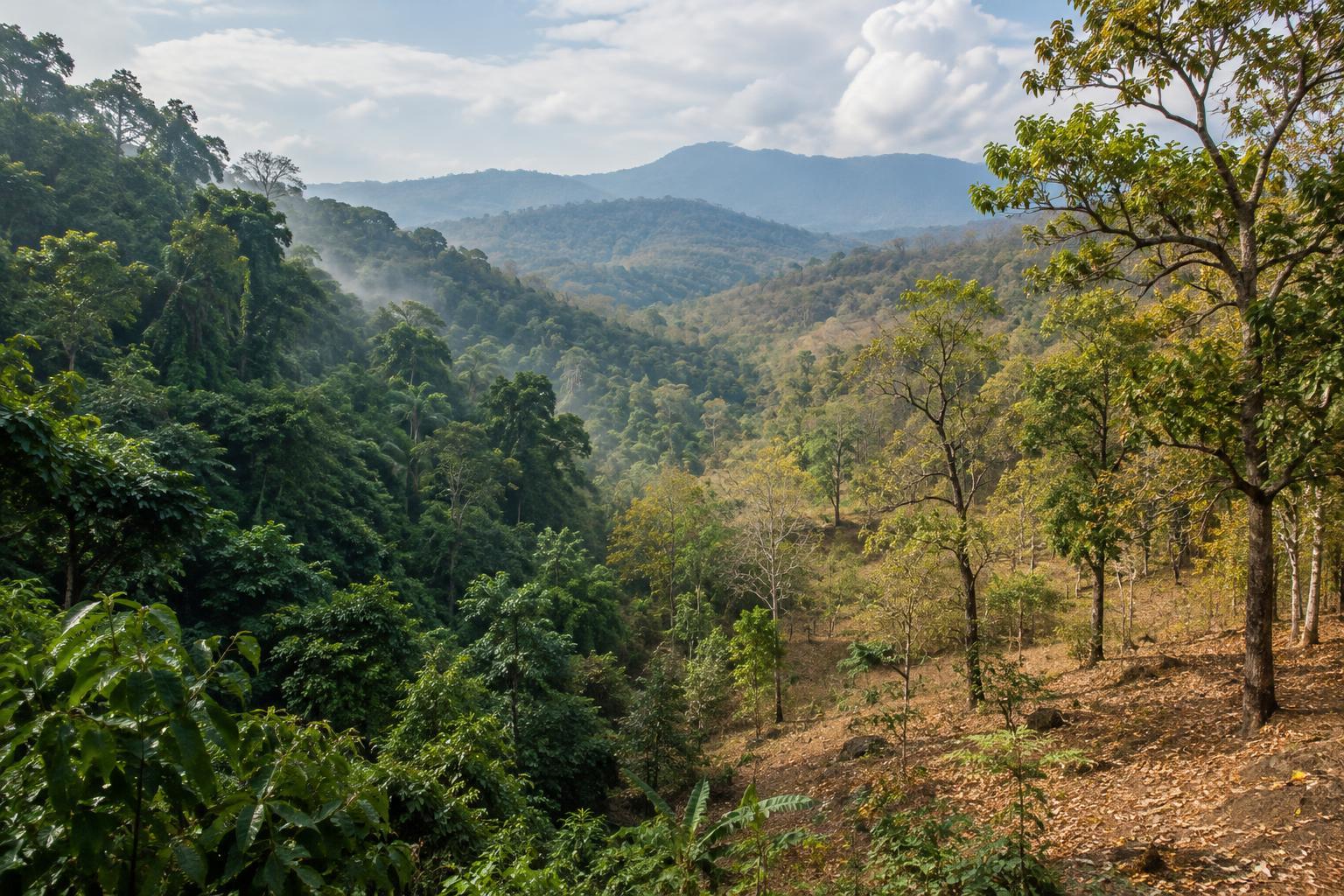
One island, different forest conditions
Java is often pictured as a uniformly lush island, but a walk through its landscapes tells a more varied story. Some forest paths remain shaded and damp for much of the year. Elsewhere, the ground can become dusty, grasses turn pale and trees lose leaves during the dry season. Rainfall matters, but so does its timing: a place that receives substantial rain in a few months may look very different from one where moisture is available more consistently.
Mountains add another layer of variation. Elevation can bring cooler temperatures and frequent cloud, while ridges and slopes influence where rain falls and how quickly water drains away. In broad terms, parts of eastern Java have a more pronounced dry season than many western areas, but local conditions can change over short distances. Rather than treating Java as a simple west-to-east sequence, it is more useful to notice the combination of rainfall, altitude, soil and human land use at each stop.
What wetter forests look and feel like
Where moisture is more dependable, forests can support a dense, layered canopy. Tall trees intercept sunlight, smaller trees and shrubs fill gaps beneath them, and vines may climb toward the light. Ferns, mosses and other moisture-loving plants are especially noticeable in shady, humid places. Fallen leaves and branches break down on the forest floor, returning nutrients to a system that is constantly growing and changing.
A wet forest is not necessarily wet in the same way everywhere. Lowland forest, a cloud-draped mountain slope and a streamside corridor can each have a different mix of plants and ground conditions. After rain, trails may be slippery and streams may rise; between showers, the canopy can still hold humidity. For a visitor, the most revealing details may be small ones: water dripping from leaves, roots gripping a steep bank, or a sudden opening where sunlight allows a different set of plants to grow.
How forests respond to a dry season
In seasonally dry forests, plants must cope with months when water is less readily available. Some trees shed leaves to reduce water loss, making the forest brighter and more open for part of the year. The same woodland can appear green and full after the rains, then sparse and brown later in the dry season. Grasses and other plants close to the ground also change visibly as moisture comes and goes.
Dry forest does not mean lifeless forest. Its seasonal rhythm creates different conditions for flowering, new leaves and animal activity. Nor is every open-looking landscape a natural dry forest. Teak stands, farmland, grazing areas and other managed land can resemble woodland from a distance, yet have different histories and structures. Looking for a mix of tree sizes, understory plants and signs of cultivation can help visitors ask better questions about what they are seeing, even when the answer is not obvious.
Why the boundary is rarely sharp
Forests shift gradually rather than ending at a neat line on a map. A sheltered valley may stay green while an exposed nearby slope dries out. A river can support a narrow strip of lush vegetation through a broader dry landscape. On higher ground, cooler air may change which plants thrive even when the surrounding region has a strong dry season.
People have also reshaped Java’s vegetation over many generations. Fields, settlements, plantations and roads interrupt or replace former forest, while protected areas may retain larger patches of native habitat. This makes it difficult to explain every landscape by rainfall alone. A useful question is not simply ‘Is this rainforest or dry forest?’ but ‘Which parts of this scene reflect climate, and which reflect land use?’ That approach makes room for the island’s ecological complexity without assuming every green hillside is untouched forest.
Reading the landscape as a traveler
If you visit a forested area, start by noticing the canopy, the ground and the available water. Are most trees leafy, or do some have bare branches? Is the understory dense, grassy or largely open? Do you see a stream, damp soil or plants clustered in a sheltered hollow? These observations are more informative when paired with the season: a dry-looking trail may become richly green after sustained rain.
Prepare for the conditions you are likely to encounter rather than assuming all forest walks are alike. Wet trails call for footwear with grip and a plan for rain; exposed dry-season walks may call for extra drinking water and sun protection. Stay on permitted paths, follow local access rules and avoid disturbing plants or wildlife. Taking time to look closely can turn a walk into a clearer picture of how rainfall, terrain and human activity together shape Java’s landscapes.


