Start with the shape of the complex
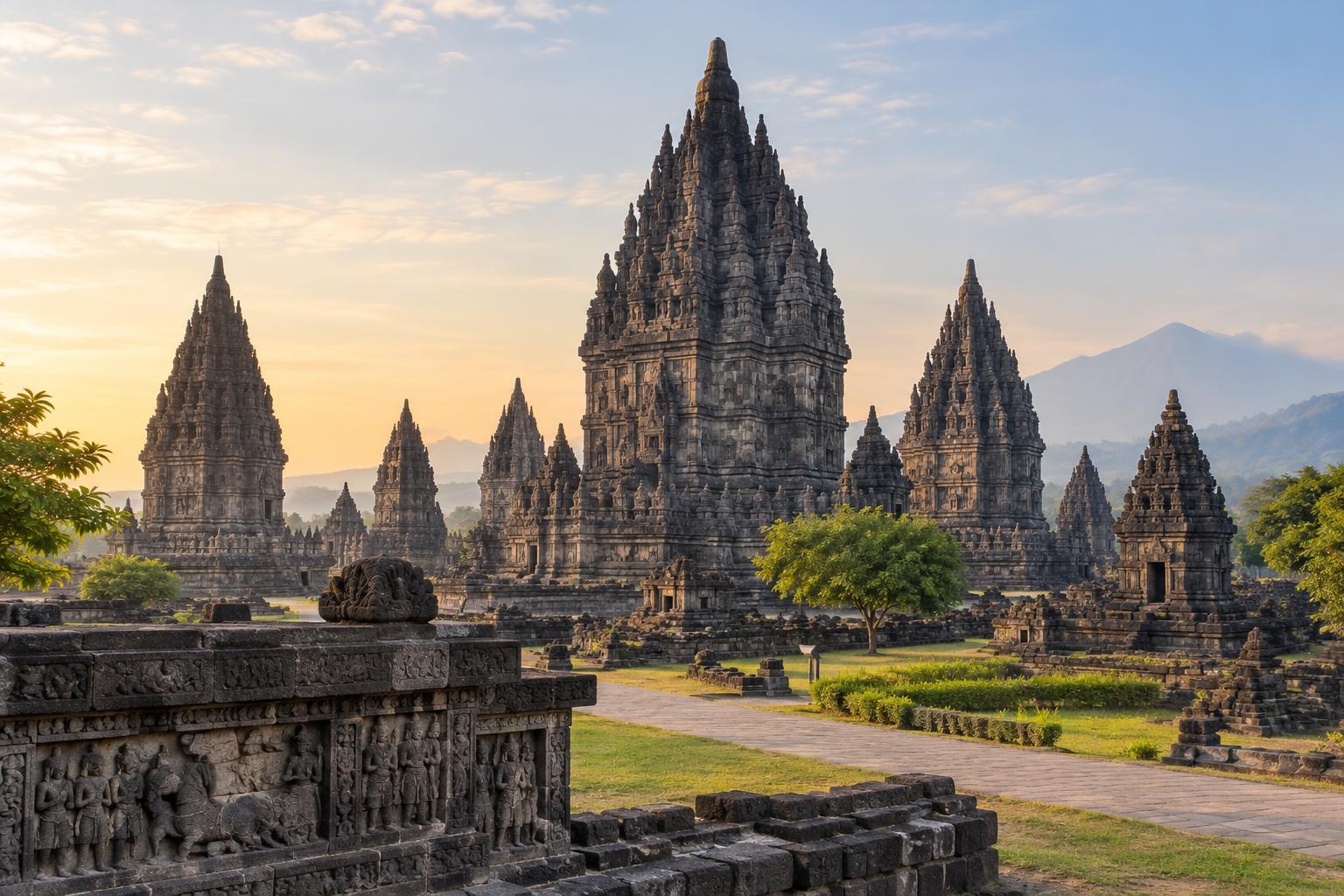
Prambanan is a Hindu temple complex near Yogyakarta, known for its steep, pointed towers and richly carved stone. A first visit is easier when you look at the whole arrangement before focusing on individual details. Paths lead toward an inner courtyard dominated by three main temples dedicated to Shiva, Vishnu and Brahma. The tallest, central temple is dedicated to Shiva. Smaller shrines and the remains of many other structures surround this core.
The towers rise in a series of smaller levels, drawing the eye upward. As you walk closer, the broad silhouette gives way to niches, stairways, guardian figures and bands of relief carving. You do not need to identify every feature to appreciate the design. Notice how the complex shifts from open space to a more concentrated group of shrines: that change helps make the inner courtyard feel distinct from the grounds around it.
Prambanan is also a place of restoration. Some structures stand tall, while others survive mainly as stones or foundations. Rather than expecting every building to look complete, use these differences to imagine the scale of the original complex and the work involved in caring for it.
Meet the deities in the main courtyard
The three principal temples provide a simple starting point for understanding Prambanan’s Hindu setting. Shiva occupies the largest central temple, with Vishnu and Brahma in the temples beside it. In broad terms, these deities are associated with transformation, preservation and creation. Their stories and meanings extend well beyond any one building, but the layout gives visitors a way to begin recognizing them.
Look across the courtyard as well as up at the towers. Smaller temples face the three main shrines and are associated with the deities’ animal companions or vehicles. Nandi, the bull linked with Shiva, is a particularly useful landmark: his shrine faces the Shiva temple. Inside the Shiva temple, visitors may also encounter images connected with Shiva’s family and traditions, including Durga and Ganesha. Access to interior spaces can vary, so the courtyard itself remains a good place to observe the relationships between the buildings.
If the names are unfamiliar, there is no need to memorize them all at once. Start with Shiva in the center and Nandi opposite him. That single pair makes the architecture feel less like a collection of separate towers and more like a planned set of connections.
Follow a story carved in stone
Prambanan’s reliefs turn a walk around a temple into an encounter with narrative. The best-known panels depict episodes from the Ramayana, a story centered on Rama, Sita and the struggle to bring Sita home after her abduction by Ravana. You can find Ramayana scenes on the Shiva temple and continue the sequence at the Brahma temple. Other carvings include decorative patterns and figures that reward a slower look even when you cannot name them.
A carved scene may be hard to read at first. Begin by looking for repeated figures, changes of setting and gestures that suggest action. Then compare neighboring panels rather than treating each as a picture on its own. A guide or an interpretive sign, where available, can help identify a particular episode; without one, it is still worthwhile to notice how the sculptors used a narrow band of stone to show movement and expression.
Prambanan has local stories as well as carved Hindu narratives. One familiar legend, often called Rara Jonggrang, offers a different way people have explained the temples. It is best approached as folklore rather than as a literal account of how the complex was built. Keeping these traditions distinct lets you appreciate both the architecture’s Hindu themes and the stories later told about the place.
Make room for an unhurried visit
Give yourself time to circle the main courtyard instead of walking straight to the tallest tower and back. Viewing a shrine from several sides reveals how its stairs, niches and relief bands fit together. Pause farther away, too: the towers are easier to compare when they share the same view. If you are visiting with others, each person can choose one detail to look for, such as an animal figure or a repeating carved pattern.
The site is exposed in places, so comfortable walking shoes, drinking water and sun protection can make the experience more pleasant. Stone steps and uneven surfaces deserve care. Follow posted access guidance and avoid touching carvings, which can be worn by repeated contact. Before travelling, check practical details such as entry arrangements and permitted areas through an appropriate official visitor information source, as these may change.
You do not need to leave with a complete account of every deity or panel. A useful first visit might be as simple as recognizing the three main temples, finding Nandi opposite Shiva and spending a few minutes following one stretch of carved story. Those observations provide a foundation for appreciating Prambanan’s architecture without rushing past its details.