A decorative umbrella with a local identity
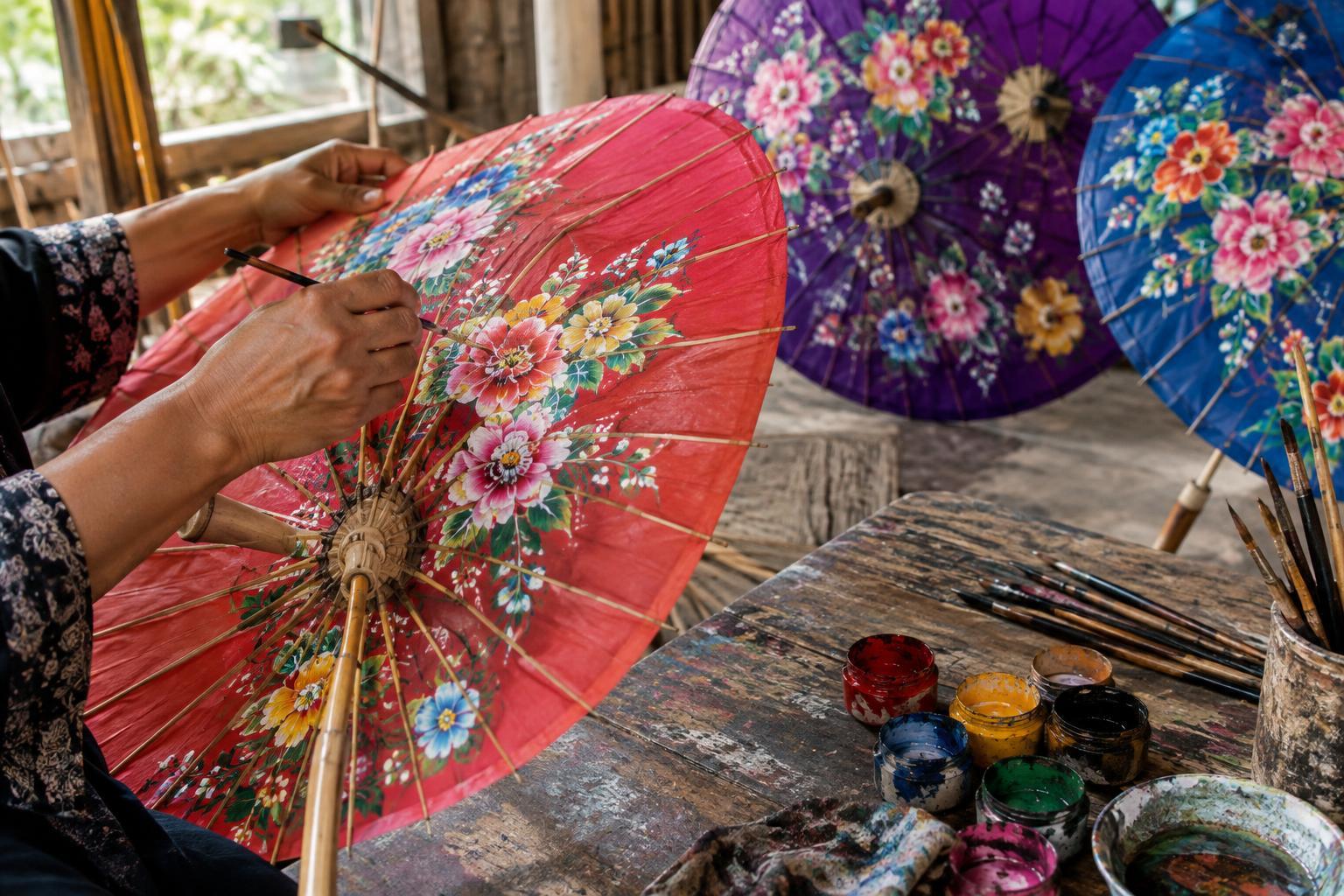
Payung geulis, often translated as “beautiful umbrella,” is a painted umbrella craft associated with Tasikmalaya in West Java. Its appeal is easy to see: a round canopy becomes a surface for color, flowers, leaves, and other ornament. Seen from a distance, several umbrellas displayed together create a lively pattern. Up close, each one reveals choices made by the people who shaped its frame and painted its surface.
Although it has the familiar form of an umbrella, payung geulis is often made chiefly for decoration. It may be displayed in a home, used as a photographic prop, or included in a cultural setting. That distinction matters when choosing one: an attractive painted canopy is not necessarily designed to withstand heavy rain or strong wind.
How the frame and canopy come together
A payung geulis begins as a structure. Makers prepare a central shaft and slender ribs, commonly using materials such as wood and bamboo. The ribs must spread evenly so the open umbrella holds its shape. A canopy of paper or fabric is then attached over the frame. Materials and construction details can vary between makers and between umbrellas intended for display and those made for more frequent handling.
Once the surface is ready, painting gives the umbrella its character. Floral designs are especially recognizable, but the balance of colors, the spacing of motifs, and the treatment of the canopy’s edge can differ. Even when a design follows a familiar pattern, hand-painted lines may show small variations. Looking at the umbrella from both above and below helps reveal how the painted surface works with the frame beneath it.
What to notice in the painted design
It is tempting to focus only on the brightest canopy, but the quieter details reward attention. Notice whether the central motif draws the eye outward, whether repeated flowers follow the curve of the ribs, and how much unpainted space the maker leaves. A simple design can be as striking as a densely decorated one when its colors and proportions feel balanced.
The painted imagery also makes payung geulis an accessible introduction to Tasikmalaya’s wider world of handicrafts. It brings practical skills and visual expression into a single object: someone must make the umbrella open and sit evenly, while someone must decide how to use its circular surface. Those tasks may be done by different hands or by one maker, depending on the workshop.
Choosing an umbrella thoughtfully
If you encounter payung geulis while traveling, ask whether a particular piece is intended for display, gentle use, or outdoor use. Open and close it carefully, if the seller invites you to do so, and check that the ribs move without being forced. Look at the joins, the attachment of the canopy, and the paint along folded areas. Minor differences in handwork need not be flaws, but a loose frame may make an umbrella difficult to display or carry.
Size matters as much as color. A large umbrella can make a memorable wall or room feature, while a smaller one may be easier to transport. Before buying, consider where it will go and how you will protect the canopy on the journey home. Asking about materials and care is also a useful way to understand the particular piece in front of you rather than assuming every payung geulis is made alike.
Caring for the craft after your visit
Treat a decorative payung geulis as a painted object with moving parts. Keep it dry unless its maker has said it is suitable for rain, and avoid leaving it in prolonged direct sunlight, which can affect some painted or paper surfaces. When opening it, give the ribs room to spread; when storing it, avoid pressure that could bend the frame. A soft, dry cloth is usually a gentler first choice than vigorous cleaning.
Payung geulis is memorable because its form invites both use and admiration. Taking time to examine its structure, ask about its materials, and handle it with care makes the experience richer than simply choosing a souvenir by color. The umbrella can then serve as a reminder not only of Tasikmalaya’s visual flair, but also of the patient work behind a handmade object.


