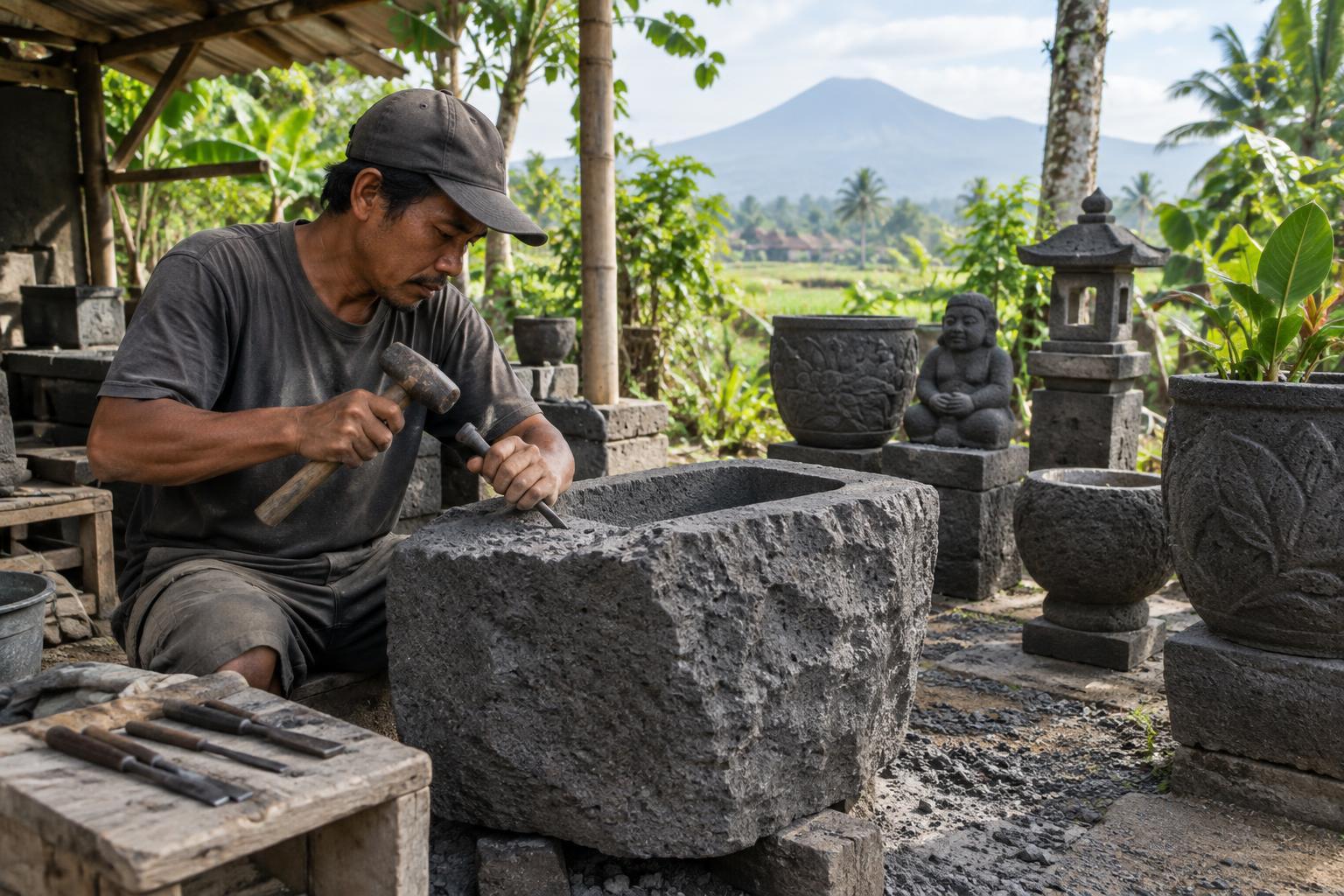
A craft rooted in the landscape
Muntilan, near Magelang in Central Java, is a place where visitors may encounter workshops and roadside displays of stonework. Statues, relief panels, fountains and planters can appear alongside simpler architectural pieces. Their shared starting point is often volcanic stone, including andesite, a material whose subdued colour and textured surface suit both detailed carving and outdoor settings.
A finished sculpture can make the work look effortless. In practice, the carver must understand a stubborn material: where its surface is sound, how a chisel will remove it, and which details can survive handling and weather. Looking at the stages between rough block and finished piece makes a workshop visit more rewarding than treating the sculptures as a row of souvenirs.
Choosing a block and planning a form
Stone intended for carving is not selected only by size. A worker needs a block large enough for the design, with a shape that will not demand excessive cutting away. Visible fractures or weak patches may limit what it can become. For a garden sculpture, the base and any projecting parts matter especially: a graceful outline still needs to stand securely and withstand being moved.
Some designs begin with a familiar form, while others respond to a particular commission or space. The intended view changes the plan. A relief for a wall concentrates detail on its front surface; a freestanding figure must make sense from several angles. A planter or fountain also has to function as an object, not just look attractive. The first marks on the stone establish proportions, leaving room to refine curves, faces or decorative patterns later.
How the carving takes shape
Carving generally moves from broad removal to finer work. A worker may cut away large areas first, then use chisels and other tools to bring out the main silhouette. As the form emerges, smaller cuts define edges, folds and surface patterns. Tool choices and the order of work vary by workshop and by design, but the principle is consistent: material removed cannot simply be put back.
The process involves repeated pauses to inspect the piece. From close up, a line might look even; from a few steps away, the overall balance may need adjustment. Depth is particularly important in relief carving, where shadows help make a shallow image legible. On a freestanding sculpture, the transitions between solid parts often need as much attention as the most recognizable features.
Finishing gives the object its final character. A surface might retain crisp chisel marks, be smoothed in selected areas, or combine several textures to catch light differently. Outdoors, rain and ordinary exposure can gradually change a stone’s appearance. That is worth remembering when comparing a newly finished piece with an older garden sculpture: their different surfaces do not necessarily reflect different levels of care.
Looking beyond the finished statue
Muntilan stonework includes more than figures. Garden pieces may use carved borders, geometric patterns or restrained shapes that leave the stone itself prominent. A basin’s rim, the placement of an opening in a planter, or the way a pedestal meets the ground can reveal careful decisions that are easy to overlook. If a piece appeals to you, walk around it if space allows and notice how its outline changes.
Sculptural subjects can draw on varied decorative traditions, but appearance alone is not enough to identify a work’s exact meaning or origin. Rather than assigning a story to an unfamiliar figure, ask the maker or seller what they can tell you about its design and intended use. Their answer may illuminate choices that a quick glance cannot: whether a feature was requested, adapted to the stone, or made for a particular garden setting.
Visiting with curiosity and care
If you stop at a working area, remember that it is a workplace first. Keep clear of tools, lifting activity and airborne dust, and ask before entering a workshop space or photographing people at work. A short, specific question about a technique or a half-finished piece can open a better conversation than assuming every worker is available to give a demonstration.
For anyone considering a piece for a garden, practical questions are as useful as aesthetic ones. Check dimensions, weight, stability and whether water needs a clear route to drain. Discuss how the piece would be moved and placed before making plans around it; even a modest-looking stone object can be difficult to handle. Whether you leave with a sculpture or simply a closer understanding of the craft, Muntilan’s stonework invites you to see a familiar landscape material as the beginning of a deliberate, patient process.


