A landscape larger than Mount Bromo
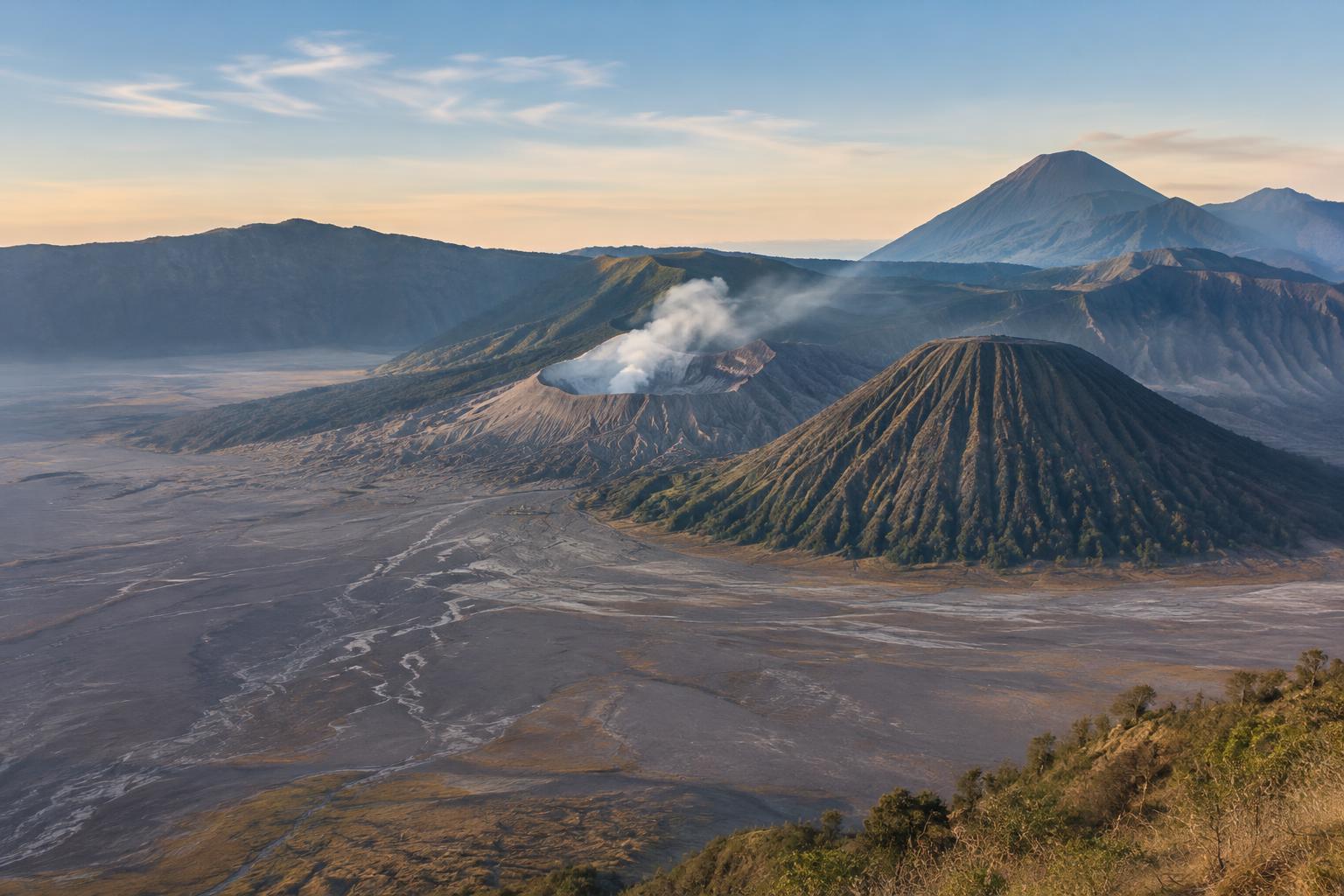
From a distant viewpoint, Mount Bromo can look like a small cone set inside a vast bowl. That impression is a useful starting point: the scene is not one isolated mountain. Bromo sits within the Tengger volcanic landscape, where an older, much larger caldera forms the broad setting for the cones and open ground visitors see today.
A caldera is a large depression associated with a volcano’s past activity. At Bromo, its rim helps frame the view, while the relatively flat floor makes the cones stand out. Thinking in layers can make the panorama easier to read: first find the high outer edge, then the broad floor within it, and finally the individual volcanic peaks rising from that floor. The most recognizable peak in a photograph is not necessarily Bromo, so it is worth checking which cone you are looking at before naming it.
What is the Sand Sea?
The Sand Sea is the wide expanse of loose volcanic material across the caldera floor. Its pale-to-dark surface can appear almost empty from above, but at ground level it has texture: tracks, wind-shaped patches and changes in color under different light. It is often described as a sea because its open sweep contrasts so sharply with the surrounding slopes and the cones rising out of it.
This is not ordinary beach sand in a coastal setting. The ground is part of an active volcanic environment, shaped by eruptions, weather and movement across the caldera. Dry conditions can bring dust, particularly when wind or vehicles disturb the surface. After rain, the same ground may look darker and feel different underfoot. These changes are good reasons to treat descriptions of an “easy walk” as conditional rather than guaranteed.
Reading the cones and the crater
Mount Bromo is the active cone that many visitors approach across the Sand Sea. From its rim, when access is permitted, the crater offers a closer sense of the volcano than a distant panorama can. Steam or gas, if visible, is a reminder that this is a changing geological site rather than a fixed scenic display. Conditions around an active crater can shift, so a view from the rim should never be assumed to be available or safe on a particular day.
The neighboring cone of Mount Batok is another prominent shape in the classic Bromo view. Its ridged sides give it a different outline from Bromo’s cratered summit. Farther peaks and the caldera wall add depth behind them. Separating these features in your mind helps explain why two photographs labeled “Mount Bromo” may seem to show different mountains: one may center on the active crater, while another emphasizes the wider volcanic group.
How viewpoints change the story
From a high viewpoint on the caldera’s edge, the Sand Sea becomes a broad foreground and the cones appear in relation to one another. This is the place to appreciate scale and shape. From the caldera floor, by contrast, the enclosing rim may feel far away and the cones become immediate landmarks. Near Bromo itself, attention narrows to slopes, steps where available, and the crater rim.
Light and cloud can simplify or obscure the scene. A clear moment may reveal the outer rim and distant peaks at once; mist may leave only the nearest cone visible. Neither view is the definitive one. If you have time, pause at more than one distance rather than treating the landscape as a single photo stop. Notice where the caldera wall runs, how the Sand Sea meets the slopes, and how a cone’s profile changes as you move.
Visiting with the terrain in mind
Plan for an exposed landscape. Layers can help with cool air at higher viewpoints, while shoes suited to loose ground make walking more comfortable. Dust protection may be useful when conditions are dry. Carry water, keep track of your route and leave room in your plans for poor visibility or changed access. Local signs and on-site guidance matter more than a route described in an older itinerary.
The Sand Sea is both a striking landscape and a place people pass through, not a blank surface to cross without thought. Stay on permitted routes, give others space on narrow approaches and avoid leaving litter. At any crater viewpoint, remain behind barriers and follow access restrictions, even if other visitors do not. The reward is not simply reaching an edge: it is understanding how the open caldera floor, Bromo’s active cone and the surrounding high ground belong to one volcanic scene.