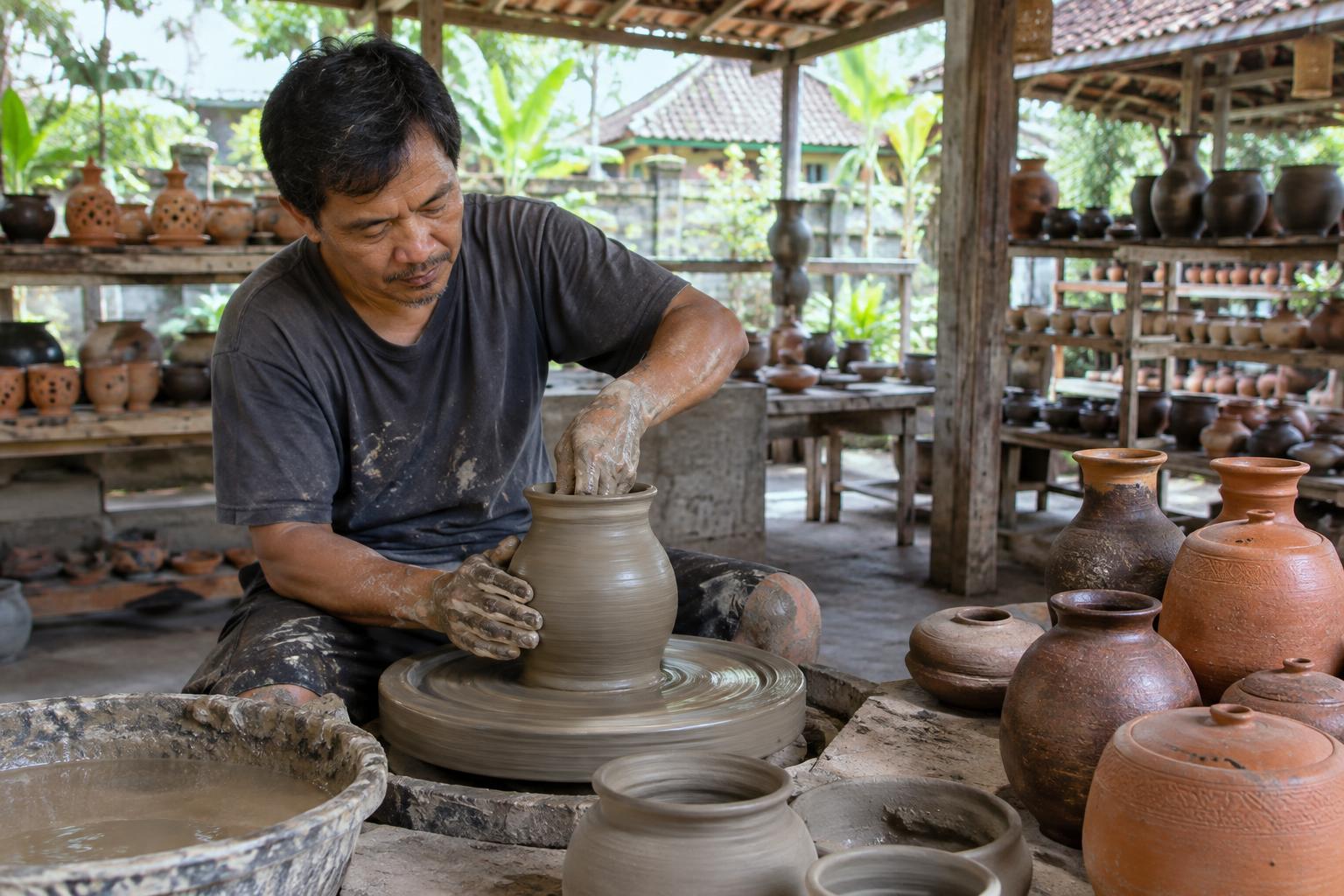
A pottery village worth slowing down for
Kasongan, near Yogyakarta, is known for its pottery workshops and shops. A visit offers more than a chance to browse finished pieces: it can help you understand the decisions behind a vessel, planter or decorative object. The shape, wall thickness, surface and firing all affect how a piece looks and how it can be used. Leaving time to look closely is often more rewarding than trying to see every display.
You may encounter both small, hand-finished objects and large decorative pieces. Not everything for sale will have been made in the room where it is displayed, and workshop practices vary. If you are curious about an object’s origin, ask where it was shaped, fired and finished. A clear answer can tell you more than a label such as “handmade,” which may describe only part of the process.
From workable clay to a shaped form
Pottery begins with clay that can be formed while damp and will hold its shape as it dries. Makers prepare it to achieve a workable texture and reduce trapped air. Depending on the object and the workshop, a piece may be shaped by hand, built from coils or slabs, pressed into a mold, or formed on a wheel. These methods are not a simple ranking of quality; each lends itself to different forms and levels of repetition.
As you watch, notice how the maker joins parts such as handles, rims and feet. Those connections need particular care because the clay must dry and shrink together. Larger forms may be built in stages rather than all at once. Before firing, the object must dry sufficiently; rushing this step can increase the risk of cracking. A workshop visit may show only one stage of a process that takes place over several days or longer.
What firing and finishing change
Firing transforms dried clay into a durable ceramic object. Kilns, temperatures and firing conditions can differ between workshops and products, so similar-looking pieces may not have the same properties. Some Kasongan pottery has the warm, earthy appearance often associated with terracotta; other pieces may be painted, glazed or given a decorative surface treatment. A smooth or shiny finish alone does not tell you whether an object is suitable for food or water.
If you intend to use a piece rather than display it, ask specific questions. Is the inside glazed? Is the vessel meant to hold water? Is it intended for serving food, or only for decoration? Has it been fired and finished for that purpose? When a seller cannot confirm its intended use, the safer choice is to treat it as decorative. For planters, check whether there is a drainage hole and whether the base needs a tray to protect a tabletop.
How to look around a workshop
A workshop is a place of work, even when visitors are welcome. Ask before entering a production area, handling unfinished pieces or photographing makers. Wet clay can be easily marked, and a shelf of drying forms may be more fragile than it appears. If a demonstration or hands-on session is offered, find out what it includes and whether your piece can realistically be fired and collected during your visit.
Look for signs of process rather than expecting a perfectly staged scene: tools within reach, pieces at different drying stages, or finished work awaiting packing. Questions about why a particular form is made, how a texture is achieved, or which part is hardest to produce can open a useful conversation. Keep questions considerate if someone is concentrating on a delicate task. A brief exchange may give you a better sense of the craft than a hurried tour.
Choosing a piece you can live with
Before buying, consider size, weight and where the object will go. Examine the rim and base, then set the piece on a level surface to see whether it sits as expected. Small variations may be part of its character, but visible cracks, loose attachments or sharp edges deserve a closer look. For sets, check each item individually rather than assuming they are identical.
Packing matters with ceramics. Ask how the shop would protect the piece for travel, especially if it has a narrow neck, projecting handles or a textured edge. You can also ask whether a larger item can be packed or shipped, but confirm the arrangements and costs before relying on that option. Choosing one object whose making and purpose you understand can be a satisfying way to remember Kasongan long after the visit.