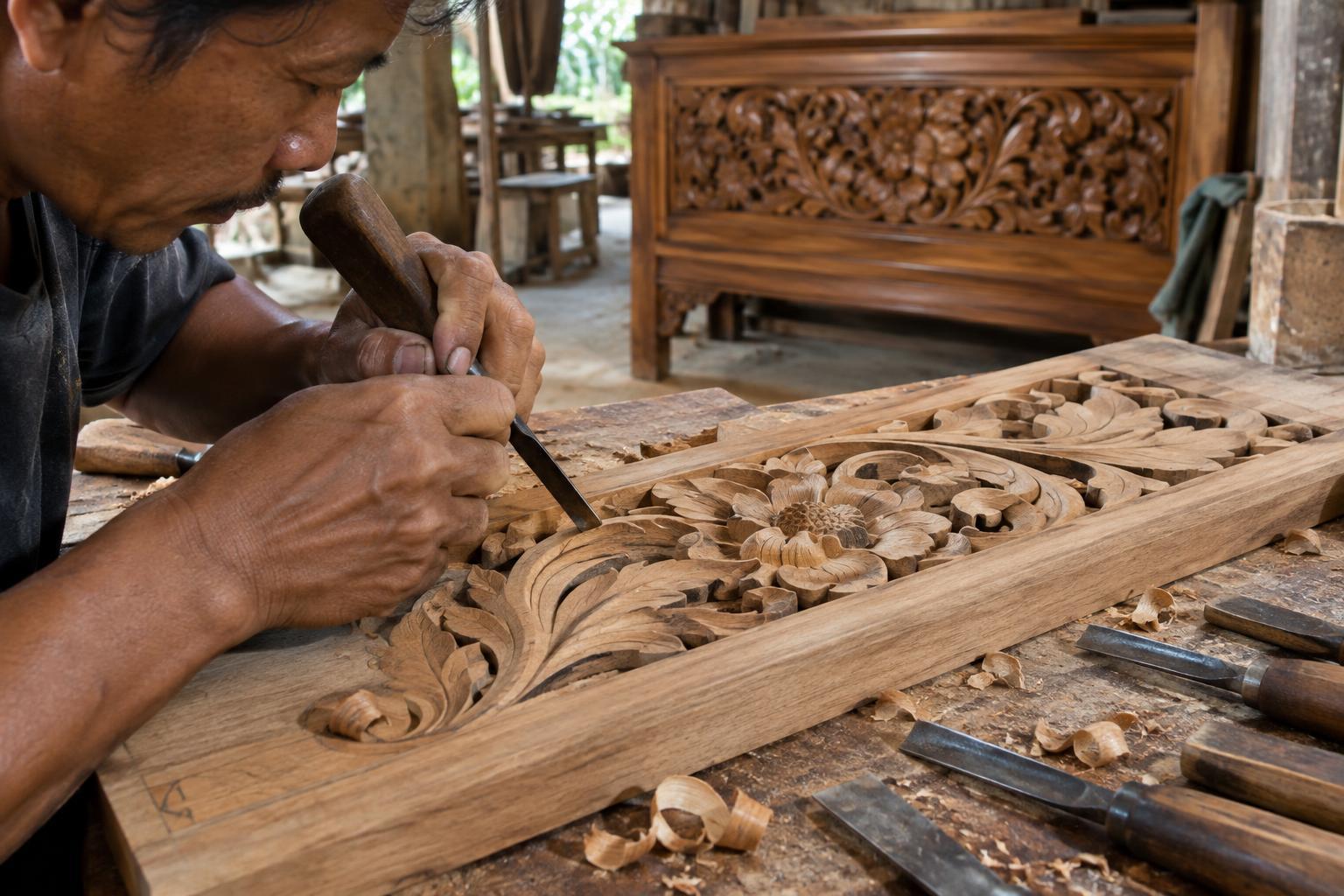
What to Notice in Jepara Woodcarving
Jepara, on Java’s north coast, is widely associated with carved wooden furniture and decorative objects. A visitor may encounter everything from an intricately worked cabinet to a small panel with a few carefully cut leaves. These pieces need not look alike: workshops, makers and customers have different tastes, and designs range from traditional-looking ornament to simpler contemporary work.
When assessing a piece, start with the overall effect rather than the amount of carving. Does the decoration suit the object’s shape and purpose? Is the pattern easy to follow, or does it become crowded where it meets a corner, handle or joint? A restrained design executed with care can be more satisfying than an elaborate one whose details are hard to distinguish.
Common Motifs and How to Read Them
Plant forms are a useful starting point. Look for curling vines, leaves, flowers and branching arrangements that flow across a panel or frame. Some designs repeat a motif in a regular rhythm; others build around a central bloom or scroll. Observe how the maker handles changes in direction. Leaves should appear connected to stems, and a pattern that turns a corner should feel composed rather than abruptly cut off.
You may also see geometric borders, animal forms or figures in decorative panels. Motifs can be adapted from wider Javanese artistic traditions, but their appearance alone does not establish a fixed meaning or origin. If a seller describes a symbol or names a particular style, ask what distinguishes that interpretation. Looking closely at the object is more useful than assuming every flower or creature carries the same story.
Assessing the Carving Itself
Good carving has intentional depth. In a floral design, the edges of a leaf should separate clearly from the background, while raised and recessed areas should work together to give the pattern shape. Check small intersections where stems overlap or petals meet. These areas reveal whether details were resolved with care or left muddled. Deep undercutting can create striking shadows, but it is not automatically better; on a frequently handled object, delicate projections may be vulnerable to damage.
Look at the carving from an angle as well as straight on. Raking light can reveal tool marks, uneven smoothing and repeated forms that vary unexpectedly. Some visible tool work adds character, particularly on a handmade piece. The question is whether the marks support a deliberate surface or distract from it. Check corners and the edges of panels, too: details should end cleanly rather than fading into rough patches.
Construction, Wood and Finish
A carved surface is only part of the object. On furniture, open and close drawers and doors gently, check whether it stands steadily, and inspect joints where parts meet. Notice whether the carving interrupts a functional area, such as a place where hands naturally grip. On a smaller object, look at the back and underside. They need not be as decorative as the front, but rough splinters, unstable fittings or poorly attached pieces are worth questioning.
Wood naturally varies in color and grain, so variation alone is not a flaw. Check instead for splits, loose sections or gaps that may affect use. A finish should let you see the form of the carving without pooling in recesses or obscuring crisp edges. Run a hand lightly over areas intended to be touched, if the seller permits it, and look for a surface that feels considered rather than merely glossy. Ask what wood was used and how the maker recommends caring for it; the answer can help you judge whether the piece suits your home and climate.
Buying with Curiosity and Care
Before choosing a piece, decide how you will use and display it. A finely pierced panel may be best where it will not be bumped, while a table or chair needs to balance decoration with everyday durability. Compare several examples if you can. This makes differences in pattern, carving depth and construction easier to see than judging one object in isolation.
Questions about who made the piece, whether parts were carved by hand or with machine assistance, and how the wood was obtained are reasonable. Production methods can vary, and a seller may not know every detail; avoid treating a single label as a guarantee of quality or origin. Give yourself time to examine the object as a whole. Jepara carving rewards close attention not just to its motifs, but to how thoughtfully those motifs are worked into something made to be lived with.


