Why the same message can sound different
In Javanese, how you say something can convey as much as what you say. Speakers may choose different vocabulary and forms of address depending on their relationship, the setting and the degree of respect they want to show. Two people can make the same request in different ways without changing its basic meaning. For a visitor, the important lesson is not to memorize a perfect script, but to notice that language choices carry social meaning.
The broad labels you may hear are ngoko, associated with familiar or informal speech, and krama, associated with more respectful or formal speech. People may also refer to intermediate usage, often called madya. Everyday conversation does not always fit neatly into these categories: speakers can mix forms, switch languages or adjust as a conversation develops. Usage varies among families, communities and regions, so a phrase that feels natural in one encounter may feel less natural in another.
Where speech levels are most noticeable
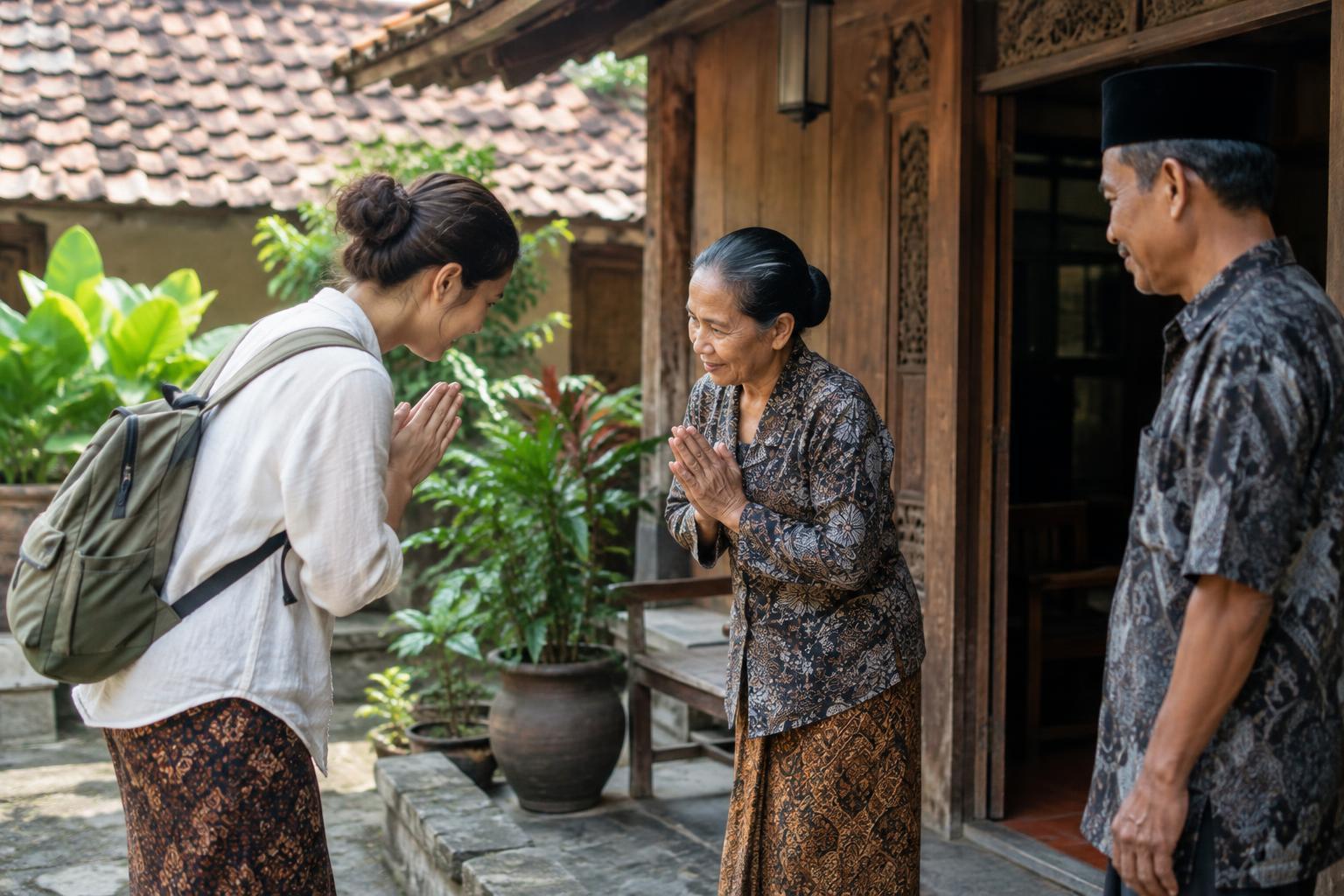
Speech levels can matter when younger people address elders, when someone speaks to a person they have just met, or when a conversation takes place in a formal setting. At a family gathering, for example, a child might speak differently to a grandparent than to a sibling. A host may also use more respectful language when welcoming a guest. These choices are not a simple ranking of people; they can express warmth, courtesy, distance or familiarity.
A visitor may hear a shift while shopping, asking for directions or joining a conversation in a household. Someone might use informal Javanese with a friend, then choose more respectful wording for an older customer. You do not need to identify every form to understand what is happening. Paying attention to tone, introductions and the way people address one another often gives you more useful guidance than trying to classify each sentence.
Indonesian is a useful, respectful starting point
If you do not speak Javanese, Indonesian is often the clearest choice for an everyday exchange in Java. It avoids the risk of choosing a Javanese speech level that does not fit the situation. A polite greeting, a straightforward question and a thank-you are usually more helpful than a memorized Javanese sentence delivered without understanding its context. Not everyone will prefer the same language, however, so follow the other person’s response.
Forms of address can help set a courteous tone. Bapak and Ibu are commonly used for adult men and women in respectful Indonesian conversation; Pak and Bu are shorter forms. Mas and Mbak may be heard when addressing young adults in many parts of Java. None is a universal formula for every person or place. If you are uncertain, listen to how others address the person, or begin with a neutral greeting and your question rather than forcing a title.
A few Javanese words, used with care
Learning a small amount of Javanese can be a welcome way to engage, provided you treat it as an opening rather than a performance. Matur nuwun is a respectful way to say thank you. In a more informal exchange, you may hear suwun. If someone teaches you a phrase, ask when they would use it and with whom. That question is often more valuable than collecting a long list of words without knowing their social setting.
Do not assume that repeating the informal language you hear between friends is the right way to address a stranger. Equally, a highly formal phrase may sound stiff in a relaxed conversation. If you try a Javanese expression and receive a reply in Indonesian, switching to Indonesian is a sensible choice. If someone offers a correction, take it as useful guidance rather than a sign that the exchange has gone badly.
Let the relationship guide the conversation
Good etiquette is less about demonstrating fluency than about giving the other person room to communicate comfortably. Speak clearly, avoid rushing a response and notice whether they prefer Indonesian, Javanese or another language. Ask simple questions when you need help, and do not presume that an older person wants formality or that a younger person wants informality. Relationships are more varied than any quick rule can capture.
For travelers, this approach turns a potentially intimidating language distinction into a practical habit: begin politely, listen and adapt. Javanese speech levels are part of the texture of everyday life, but they are not a test visitors must pass. Showing interest while accepting that you may not understand every nuance is a thoughtful way to take part in an encounter.


