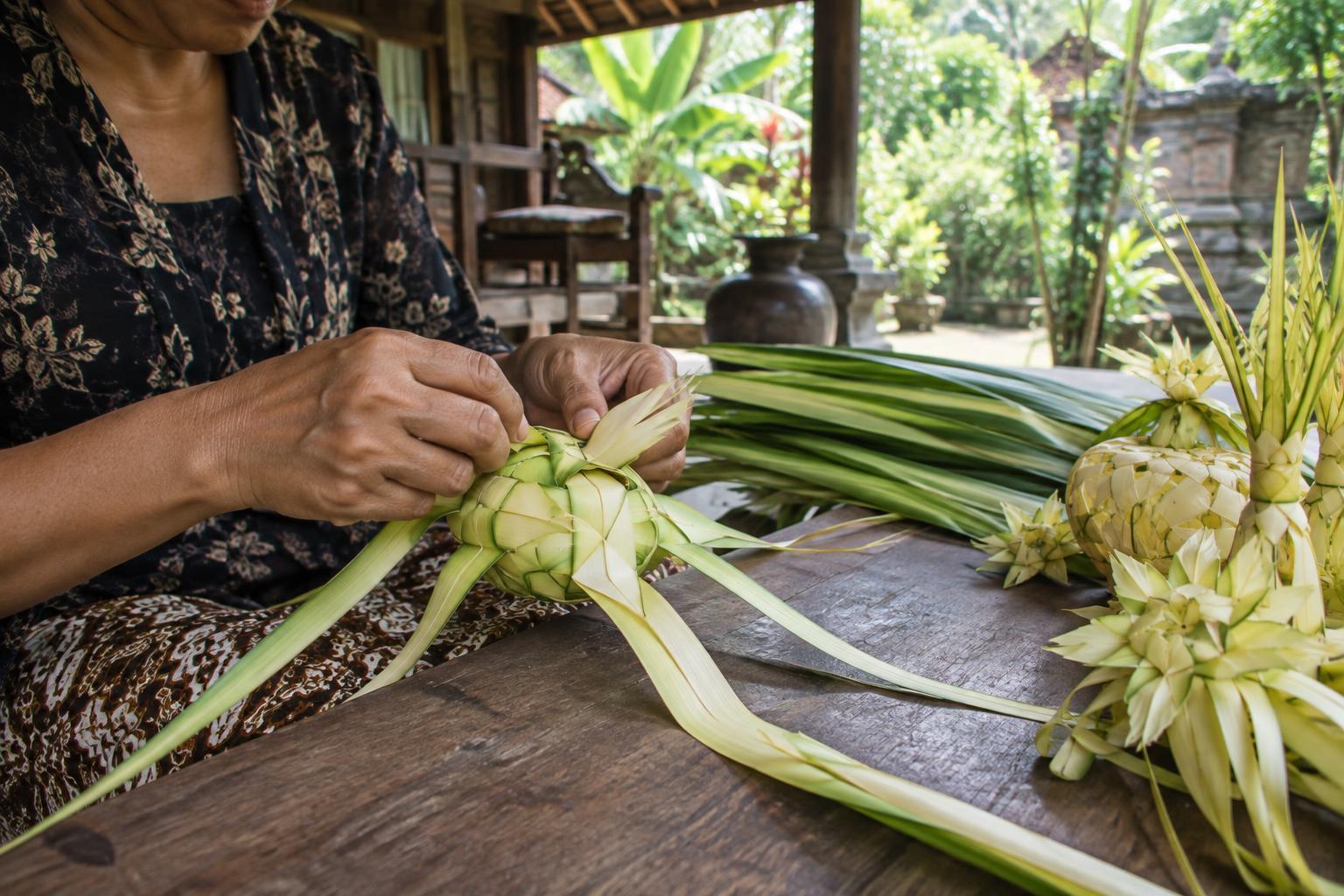
A craft made for a moment
Not every handicraft is meant to last for years. In Java, young coconut leaves, often called janur, can become hanging ornaments, woven containers and other decorations for gatherings. Their pale color and flexible shape make them suitable for work that is assembled by hand and displayed while the leaves are fresh. The finished pieces may be modest or elaborate, depending on their purpose and the maker’s skill.
Janur decorations are sometimes associated with weddings and other celebrations, but their forms and meanings vary by place and occasion. It is better to ask about a particular arrangement than to assume every woven leaf carries the same symbolism. Looking closely at this temporary craft offers a different way to appreciate workmanship: its value lies not in permanence, but in the care taken over a short-lived object.
Why the leaf matters
Young coconut leaves are easier to bend than mature ones, yet they still have enough structure to hold a fold. A maker may separate leaflets, trim them to size or work with a longer strip attached to its central rib. Evenness matters: strips of similar width help a repeated pattern sit neatly, while a strong central rib can support a taller arrangement. The exact preparation depends on the intended shape.
Freshness affects the pace of the work. A supple leaf can be turned and tucked without breaking as readily as a dry one. Over time, however, the material changes color and becomes more brittle. That is a normal characteristic of a fresh-leaf decoration, not necessarily a flaw in its making. When looking at a piece, notice how its design makes use of the leaf’s natural taper, length and gentle curve.
Reading the folds
A simple janur ornament may use repeated bends to create a clear rhythm. More complex pieces can combine loops, pointed tips and interlaced strips. Instead of judging a decoration only by its size, look at how steadily its edges run, whether repeated elements are spaced with intention and how securely the ends are tucked. Small variations can show the handwork involved without making the whole arrangement look untidy.
It also helps to look at the piece from the angle at which it will be displayed. A hanging ornament needs a readable outline from a distance; a small woven container may reward closer inspection of its corners and base. Some decorations rely on additional supports or fastenings. If you are buying one, ask how it should be carried and hung rather than testing its strength by pulling on a delicate fold.
Watching or commissioning the work
If you encounter someone weaving janur at a market or preparing decorations for an event, first check whether watching is welcome. A maker working to a deadline may have little time to explain each step. Keep your hands clear of the prepared leaves, tools and finished pieces, and ask before taking photographs. Where an arrangement belongs to a private gathering or ceremony, follow the hosts’ lead rather than treating it as a public display.
For a purchase or commission, describe where and when you plan to use the decoration. Its size, means of hanging and expected travel time are more useful details than simply asking for the most elaborate design. Agree on the shape and price before the work begins, and allow for the fact that a handmade fresh-leaf piece may not match another exactly. Asking about a design’s intended use can also prevent a decorative choice from feeling out of place.
Transport, display and disposal
Janur is best treated as a fresh material. Carry finished pieces without crushing their folds, and keep them away from prolonged heat where practical. If you need to travel with one, ask the maker whether it can be laid flat or needs to remain upright. Display it where people can see its shape without brushing against it. Expect it to dry and change color rather than trying to preserve its original appearance indefinitely.
When the gathering is over, check for wire, plastic ties or other added materials before disposing of the leaves. Local arrangements for organic waste differ, so use the options available where you are rather than assuming every piece can be composted whole. This small final step suits the character of janur weaving: a decoration made with care for a particular occasion, then cleared away with equal care.