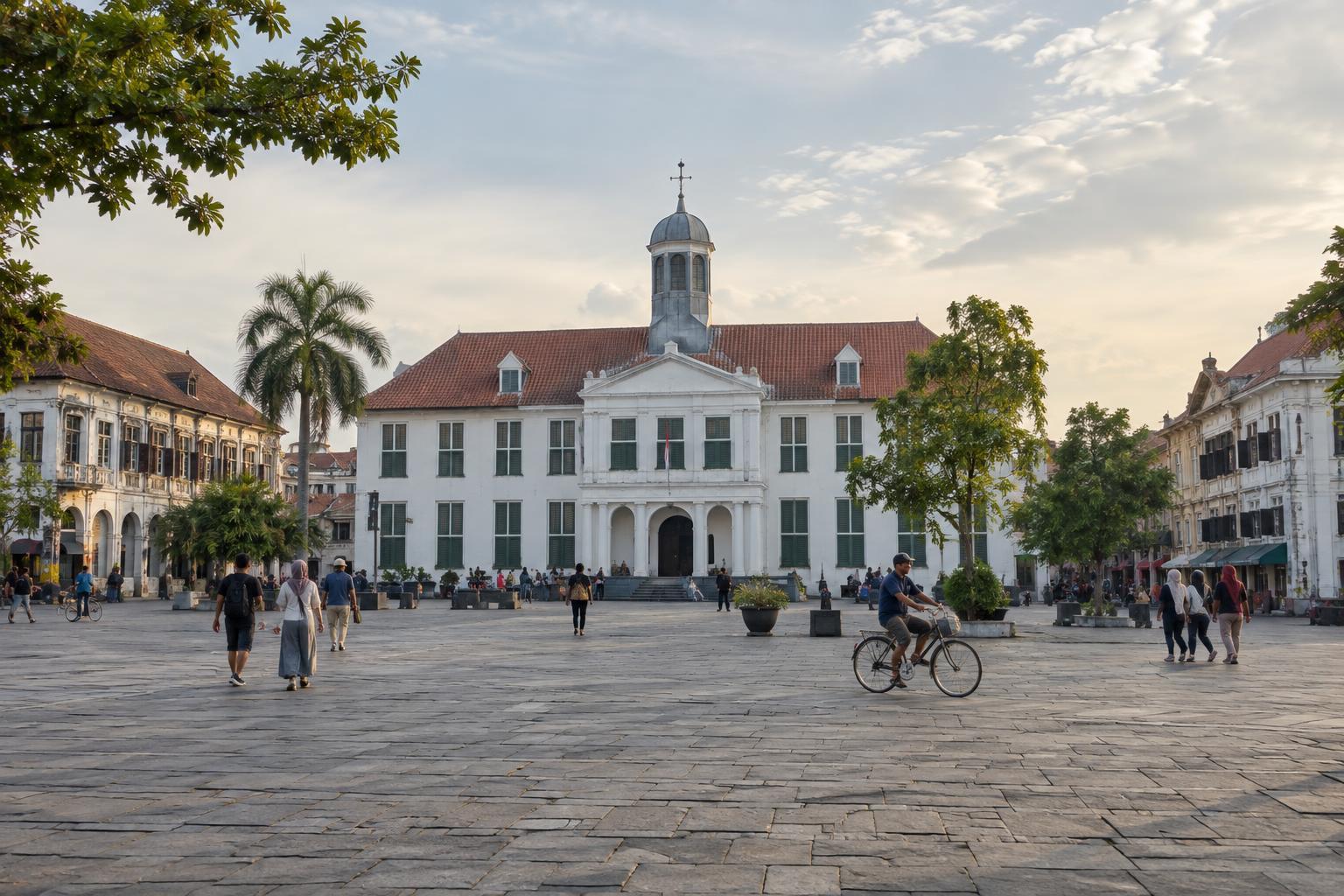
Start with the shape of the district
Kota Tua, often called Jakarta’s Old Town, rewards a slower kind of visit. Instead of treating each historic building as a separate stop, begin by noticing how the streets fit together. Straight stretches, intersections and open spaces offer clues to the planned colonial city of Batavia. The layout can be easier to understand on foot than from a photograph: walk a block, turn around and see how one view leads toward another.
Fatahillah Square makes a useful starting point. Its broad open space and the prominent former town hall, now the Jakarta History Museum, suggest how public authority was given a visible place in the city. Look beyond the most photographed facade. Consider where streets enter the square, which buildings face it and how much room is set aside for gathering. These relationships reveal more about the streetscape than any single architectural detail.
Look for clues in facades and building uses
A facade can tell you what a building was meant to project, though not always how it was used throughout its life. Formal entrances, repeated windows and balanced fronts may signal institutions or commerce. Narrower frontages and ground-floor openings can suggest spaces shaped by trade and daily work. Rooflines, shutters and shaded openings also invite questions about how people adapted buildings to heat, rain and changing needs.
Resist the temptation to label every old-looking structure as unchanged colonial architecture. Kota Tua’s buildings have been repaired, altered, reused and sometimes reconstructed. A fresh coat of paint may make neighboring facades appear to belong to one moment even when their histories differ. Look for changes in materials, window shapes and ground-floor entrances. They are reminders that this is a working part of Jakarta, not a city preserved at a single point in time.
Follow the water—and the work
Canals and waterways are another key to reading old Batavia. They were part of a city connected to shipping and trade, but they also posed practical questions about drainage and maintenance. Where you encounter a canal, pause to consider its relationship to the street beside it: Do buildings face the water or turn away from it? Where are the crossings? Such observations help explain why a streetscape took its particular shape.
Waterfront connections should not be mistaken for a simple story of prosperity. Colonial trade depended on unequal power and on the labor of people whose lives are less visible in surviving buildings. Offices, warehouses and civic spaces can show where decisions and goods were concentrated; they do not, by themselves, represent everyone who made the city function. Reading the district well means asking whose work an impressive facade conceals.
Put the colonial view in context
Kota Tua is often introduced through European-style buildings, yet Jakarta’s history cannot be reduced to their design. The colonial city was shaped by encounters and inequalities involving many communities. Its streets have also remained in use long after colonial rule. A museum visit can provide context, but leave time to notice how people occupy the area today—as a place to meet, work, eat or pass through.
This approach makes room for both appreciation and scrutiny. You can admire the scale of a square or the craft in an old doorway without treating the era that produced it as a romantic backdrop. Ask what a building was built to do, who could enter it and how its purpose may have changed. If an interpretation feels incomplete, hold that question open rather than filling the gap with a guess.
Make a short walk more rewarding
Choose a modest walking area around Fatahillah Square and nearby streets rather than trying to see every landmark at once. First take in the wider layout; then return to examine details such as doorways, corners and the meeting points between old and newer structures. Comparing two views of the same street often reveals more than adding another stop. If you enter a museum, use what you learn there to revisit the outdoor spaces with fresh questions.
Expect uneven walking conditions and allow for Jakarta’s heat and rain. Check opening information before making a museum central to your plans, and be considerate when photographing people or active businesses. Above all, let the present-day district remain part of the experience. Kota Tua’s value lies not only in what has survived, but in the chance to see how layers of planning, power and everyday life share the same streets.


