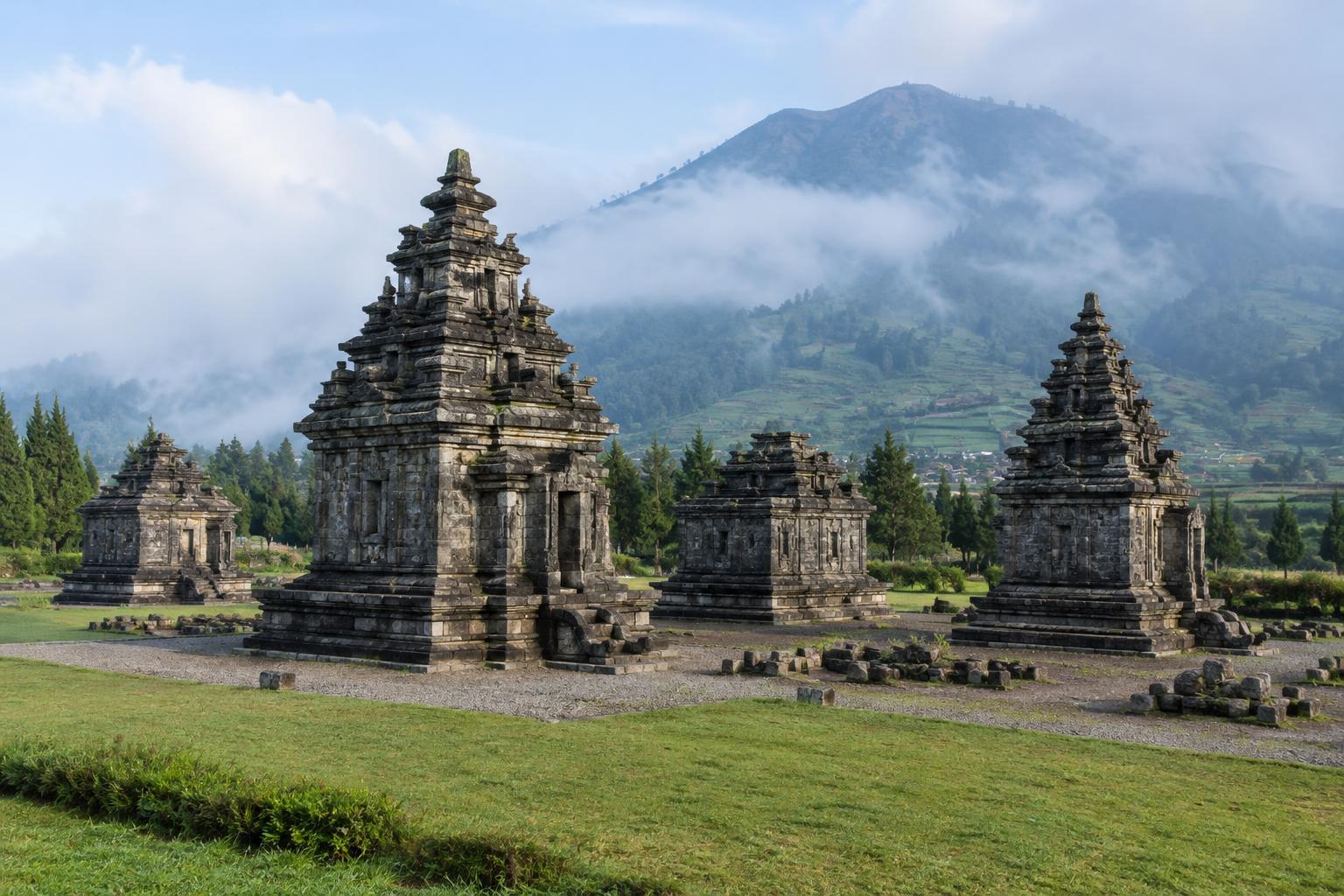
A temple landscape, not one enormous monument
High on Central Java’s Dieng Plateau, ancient stone temples occupy a landscape of fields, settlements and volcanic terrain. The best-known group is the Arjuna complex, where several modest shrines stand close together. Their scale can surprise visitors accustomed to Java’s much larger temple sites. At Dieng, the spaces between buildings matter as much as the buildings themselves.
The temples are generally associated with an early period of Hindu worship in Java, particularly traditions centered on Shiva. Their precise building dates and original arrangements are not settled in every detail. What survives is also only part of the story: structures have been damaged, repaired and rearranged over time. Rather than treating today’s layout as a complete blueprint, it is more useful to ask what its visible relationships suggest.
Reading the Arjuna complex as a group
At Arjuna, a row of shrines creates a clear sense of sequence. Visitors can move along the group and compare entrances, roof forms and carved details from one building to the next. A smaller structure stands across from the main shrine, forming a more direct relationship between two buildings. The layout draws attention to the space they share, not just to an individual doorway or tower.
That arrangement suggests a place designed for movement and ritual attention. A person approaching a shrine would encounter other structures and open ground along the way. Yet the surviving stones do not tell us exactly how every ceremony unfolded, who could enter each building or whether all the shrines served the same purpose at the same time. The layout provides evidence of planned relationships without supplying a full account of daily practice.
Why separate shrines matter
Dieng’s temples do not form a single vast enclosure. Smaller clusters and individual remains appear across the plateau. This distribution is a reminder that a sacred place need not have had one monumental center or one fixed route through it. Different shrines could create distinct points of focus within a wider landscape.
The variety also cautions against assuming that the whole site was built in one campaign. Differences in size, form and position may reflect changing needs or successive phases of construction, though the layout alone cannot establish an exact sequence. For visitors, the practical lesson is to look for patterns while leaving room for uncertainty: which buildings seem to address one another, and which occupy separate spaces?
The mountain setting is part of the picture
Dieng’s upland setting helps distinguish it from temples built on Java’s lower plains. Open skies, cool air and surrounding volcanic landforms make the stone buildings feel closely tied to their location. The setting can help us imagine the effort involved in bringing materials, builders and worshippers to a high plateau, without assuming that every nearby natural feature had a known ceremonial role.
The present landscape is not identical to the one early builders saw. Farming, roads, settlement and conservation work have shaped how the temples are approached today. Even so, standing back from a shrine rather than viewing it only at close range reveals how compact the architecture is against the breadth of the plateau. That contrast is central to the experience of Dieng.
How to look closely without overreading
Begin with the group as a whole. Notice the gaps between shrines, the direction of their entrances and the way a smaller building may face a larger one. Then move closer to compare bases, doorways and roofs. If an element looks unusually crisp or incomplete, remember that a surviving temple may include restored sections alongside older stone.
Dieng rewards patient observation more than a search for a single secret meaning. Its layout shows that early Java’s sacred architecture could be intimate, grouped and responsive to place. It cannot, on its own, tell us everything about the people who built or used it. Holding both ideas together makes the temples more interesting: they are material evidence of deliberate choices, set within a landscape whose history is still only partly visible.


