One craft, many visual languages
A batik cloth may catch your eye first through its color: warm brown and cream, perhaps, or a bright field of red, blue and flowers. Look longer and you begin to see another story in the pattern. Repeated diagonals, carefully spaced circles, curling clouds and crowded bouquets can offer clues about where a design developed and how it was intended to be seen.
In Java, people often use “court” and “coastal” as broad ways to describe batik styles. Court batik is closely associated with the inland royal centers of Yogyakarta and Surakarta. Coastal batik refers to traditions shaped in towns along Java’s north coast, including Cirebon, Pekalongan and Lasem. These are useful starting points, not strict labels. Makers borrow ideas, colors travel, and a single workshop may produce several styles.
The craft itself also deserves attention. In batik, wax protects selected areas of cloth while dye colors the exposed fabric. Artisans may apply wax by hand with a canting, stamp it with a cap, or combine methods. Multiple rounds of waxing and dyeing can build intricate layers. When comparing styles, notice not only the motif but also how the lines, background and colors work together.
The measured rhythm of court batik
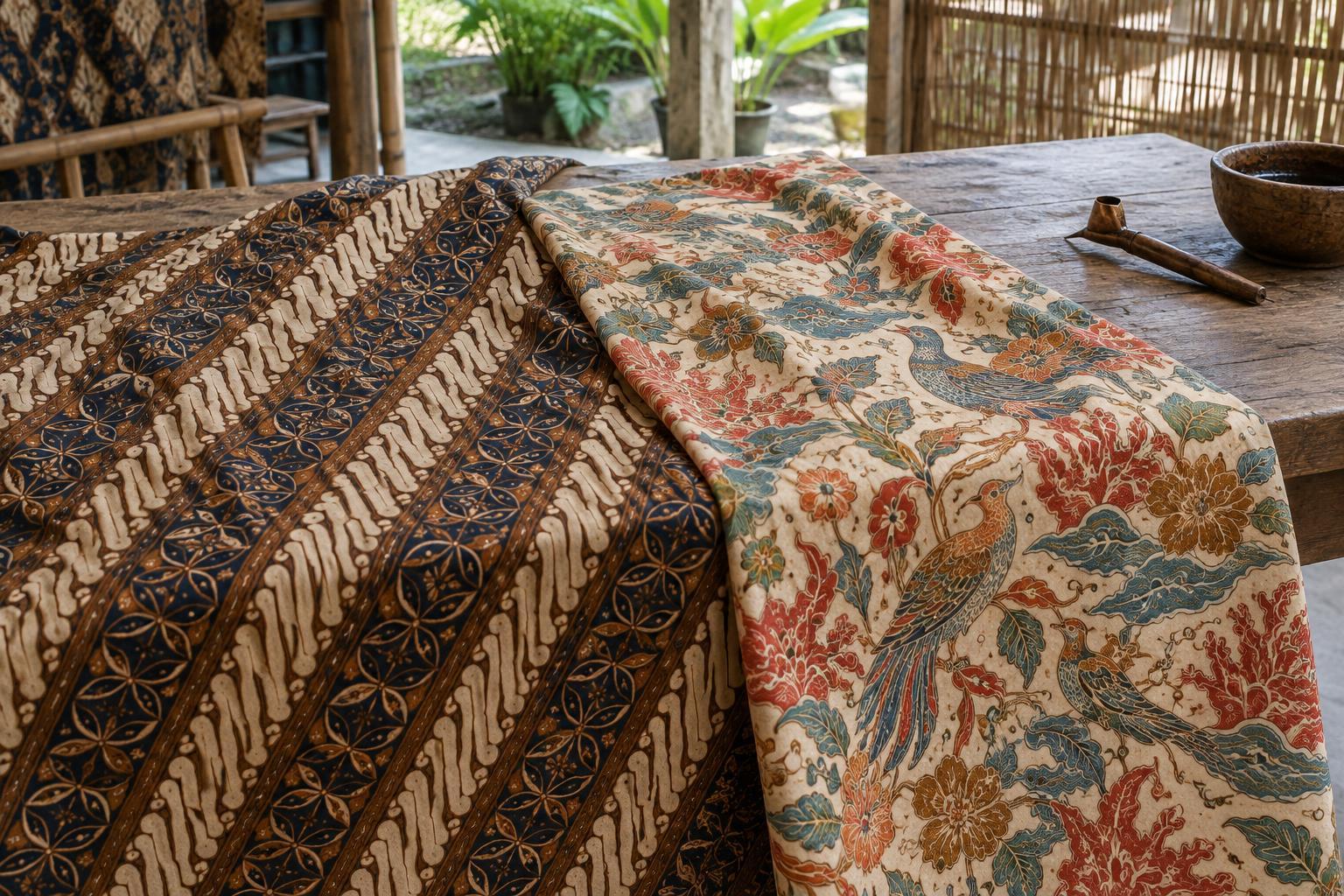
Batik associated with the courts of Yogyakarta and Surakarta often favors a restrained palette: deep brown, sometimes called sogan, alongside indigo, black and undyed or cream-colored areas. The effect can be quiet from a distance and remarkably detailed up close. Small marks fill spaces between larger forms, giving the design a steady visual rhythm.
Among the patterns you may encounter are parang, with its strong diagonal movement; kawung, built from repeated rounded forms; and truntum, a scattering of small star-like shapes. Motifs can carry customary associations, but their meanings are not always singular or universal. They may vary with the cloth’s setting, the person explaining it and the way a design has changed over time.
Court connections also shaped ideas about when particular patterns were worn. Rather than assuming every old-looking motif has the same rules everywhere, ask about a cloth’s specific pattern and context. A contemporary piece inspired by a court design may be made for everyday use, while a cloth prepared for a ceremony may invite a more careful choice.
The varied palettes of the north coast
Coastal batik is often more varied in color and imagery, reflecting the exchange of goods and ideas in trading towns. Floral arrangements, birds, plants and other representational forms sit alongside geometric elements. Yet “coastal” does not mean every cloth is bright or busy. Each center has its own habits, and individual makers make different choices.
Cirebon is particularly associated with mega mendung, a layered cloud motif that can appear in blues or other colors. Pekalongan is known for a broad range of lively designs, including bouquets often described as buketan. In Lasem, rich reds are a recognizable feature of many cloths. These examples are helpful visual landmarks, but they are not guarantees of origin: motifs can be copied, adapted and made elsewhere.
Look at how a motif occupies the surface. Some coastal designs give a flower, bird or cloud room to stand out; others place many details close together. The contrast with court batik is therefore about more than bright versus muted color. It is also about composition, subject matter and the influences a maker chooses to bring into the cloth.
How to look at a cloth without reducing it to a label
Start with the overall arrangement. Is the pattern repeated evenly across the fabric, or are larger scenes and objects the focus? Next, follow a line. Hand-drawn waxwork may reveal small variations that give repeated forms an individual character; stamped work can offer its own pleasing precision. Neither method alone tells you whether a design is meaningful or well made.
Then consider the palette and ask what you can actually identify. Brown and indigo may suggest an inland court influence, while vivid flowers may suggest a coastal one, but color by itself cannot establish where a cloth was produced. Modern dyes, changing tastes and shared patterns complicate any quick judgment. If a seller or maker can explain the technique, motif and place of production, that account is more useful than guessing from appearance alone.
Seeing batik this way makes room for both tradition and invention. A cloth can draw on an established vocabulary without being a historical example of it. The most rewarding question is often not “Which box does this fit?” but “What choices did the maker make, and how do they change the way the pattern feels?”
Choosing batik thoughtfully while traveling
If you plan to bring a cloth home, take time to handle and compare pieces where that is welcome. Ask whether a design is hand-drawn, stamped or a combination, and whether it is batik made with wax resist rather than fabric printed to resemble batik. Those distinctions can help you understand the work involved without treating one option as the only worthwhile choice.
Ask about care before washing or wearing a new piece; dye and fabric may call for different handling. If you are choosing batik for a particular occasion, local guidance can help you avoid making assumptions about a motif’s use. And if a pattern appeals to you simply as an everyday textile, it is fine to say so. Curiosity, patient looking and clear questions are better companions than a rigid checklist of court and coastal traits.