Why rattan suits furniture making
Rattan is a climbing palm whose long stems can be cut, shaped and worked into furniture. In the Cirebon area of West Java, workshops make pieces ranging from open-weave chairs to cabinets with closely woven panels. Designs vary: some emphasize the natural look of the material, while others combine rattan with wood, metal, upholstery or paint. Looking closely at how a piece is built is more useful than assuming every item follows one traditional pattern.
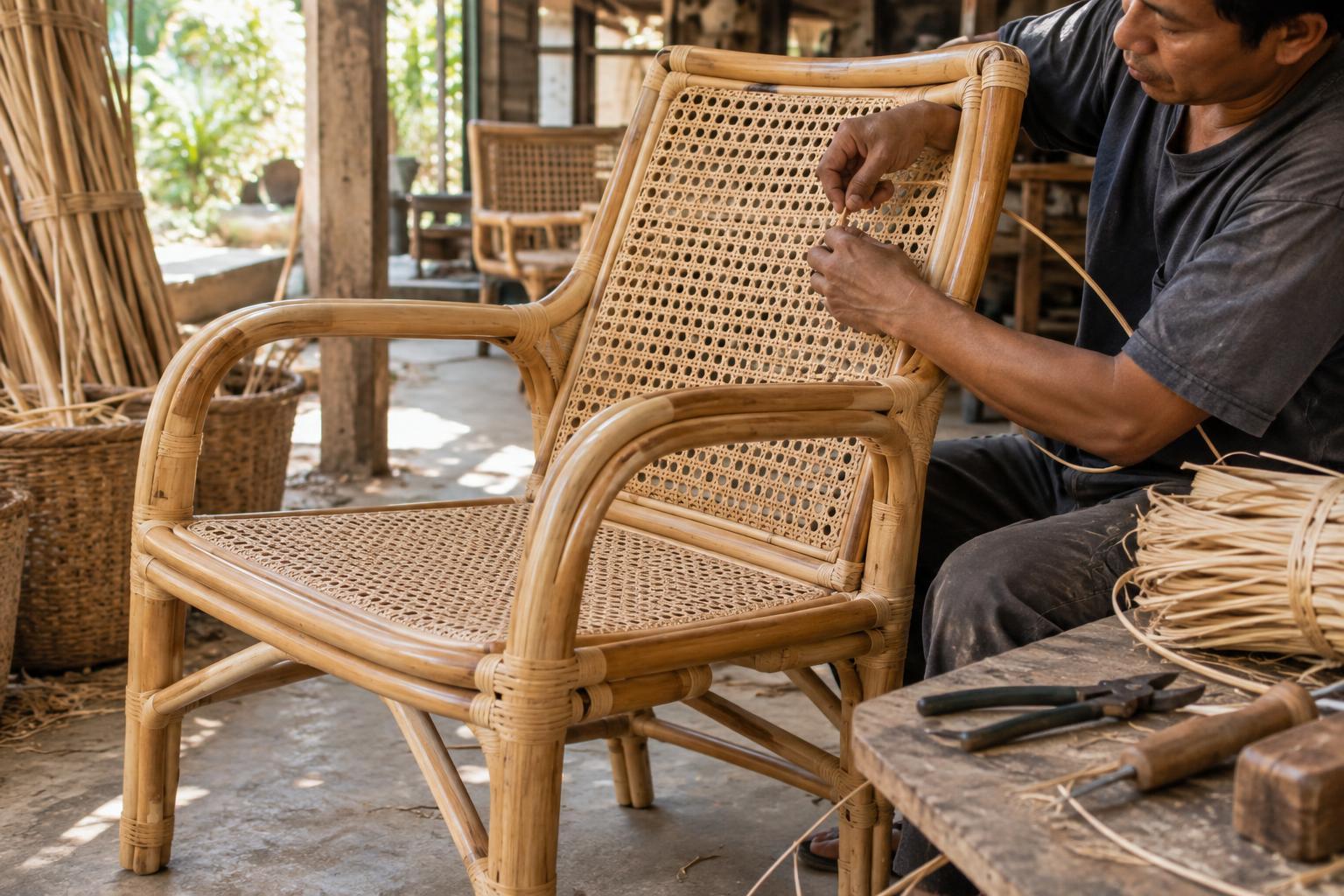
It helps to distinguish structural rattan from the thinner material used for weaving. Thicker lengths may form the legs, arms and curved outline of a chair. Narrower strips or round strands can fill its seat and back. A chair may also use a solid base beneath a decorative woven surface, so the visible pattern does not always tell you what carries the weight.
How a woven piece comes together
Work generally begins with a frame. The maker selects lengths suited to each part, cuts them and shapes curves where the design requires them. After the frame is assembled, woven sections are attached or built directly between its members. The exact sequence depends on the workshop and the design: a removable panel, for example, is constructed differently from a seat woven onto a chair frame.
For a woven surface, the maker establishes strands in one direction, then passes other strands over and under them. Changing the spacing or the over-and-under sequence creates different textures. At an edge, strands need to be secured neatly so that the pattern stays under tension and exposed ends do not catch on clothing. Bindings around joints can help secure or conceal a connection, but they should not be mistaken for proof that the joint beneath is sound.
Finally, the surface may be trimmed, smoothed and finished. Stains, clear coatings and paint all change its appearance; they can also make construction details harder to see. A uniform color is therefore not a quality test by itself. Natural rattan can show modest variation in tone and thickness, while a well-made piece should still feel consistent where hands, backs and legs touch it.
Check the frame before the pattern
Start with stability. Set a chair on a level surface and press gently on its arms and back. It should not rock because of an uneven frame or feel as though joints are shifting. For a table or cabinet, check whether it stands evenly and whether doors or drawers move without scraping. A slightly flexible woven seat can be normal; movement at a structural connection deserves a closer look.
Inspect the areas that do the most work: leg-to-seat connections, arm supports, corners and the underside. Look for cracks that run through a structural piece, loose fasteners, separating joins or bindings that appear to hide gaps. Bend marks and changes in thickness may be part of the material, but abrupt weak points in load-bearing areas are worth questioning. If a piece will be used daily, try it in the way you intend to use it rather than judging it only from a display angle.
Read the weave with your hands and eyes
Look across the woven panels for reasonably even spacing and firm edges. Gently press several points on a seat or back: the response should feel consistent, without a single area sagging markedly more than its neighbors. Check that strand ends are tucked away and that the surface is free of sharp splinters. On a tightly patterned panel, small handmade differences need not be defects, but loose runs that can be lifted easily may worsen with use.
Ask what materials are used in each part, particularly if a piece mixes natural rattan with synthetic weave or other components. Neither mixture nor a protective finish is automatically a problem; the answer helps you judge whether the item suits its intended location and how you will care for it. Natural rattan is generally better kept away from prolonged dampness and harsh exposure unless the maker gives specific guidance for that piece.
Choose for your space, not just its appearance
Before buying, measure doorways and the place where the furniture will sit. Check seat height and depth, arm clearance and the weight of a piece if you expect to move it often. Sit in chairs long enough to notice whether the frame supports you comfortably and whether the weave or finish catches on clothing.
If possible, ask how to clean the item and whether damaged woven sections can be repaired. Regular dusting with a soft brush or cloth can help keep debris out of the weave; avoid soaking natural rattan unless the maker’s care instructions permit it. A good choice is one whose construction you can inspect, whose materials you understand and whose size and care needs fit everyday life.


