A mask begins with a character
A Cirebon topeng mask is more than a carved face. In topeng dance, its features help a performer present a character through movement, costume and music. The maker must think about both expression and wearability: a mask needs to read clearly from a distance while resting comfortably enough on the dancer’s face. That combination gives the craft its particular challenge.
Panji, Samba, Rumyang, Tumenggung and Kelana are among the characters often associated with Cirebon topeng. Their faces can suggest different temperaments through the shape of the eyes, brows, nose and mouth, as well as through colour. These details are not a rigid code shared by every maker or performance tradition. Looking at several masks of the same character can be more revealing than trying to identify one by colour alone.
From a piece of wood to a wearable face
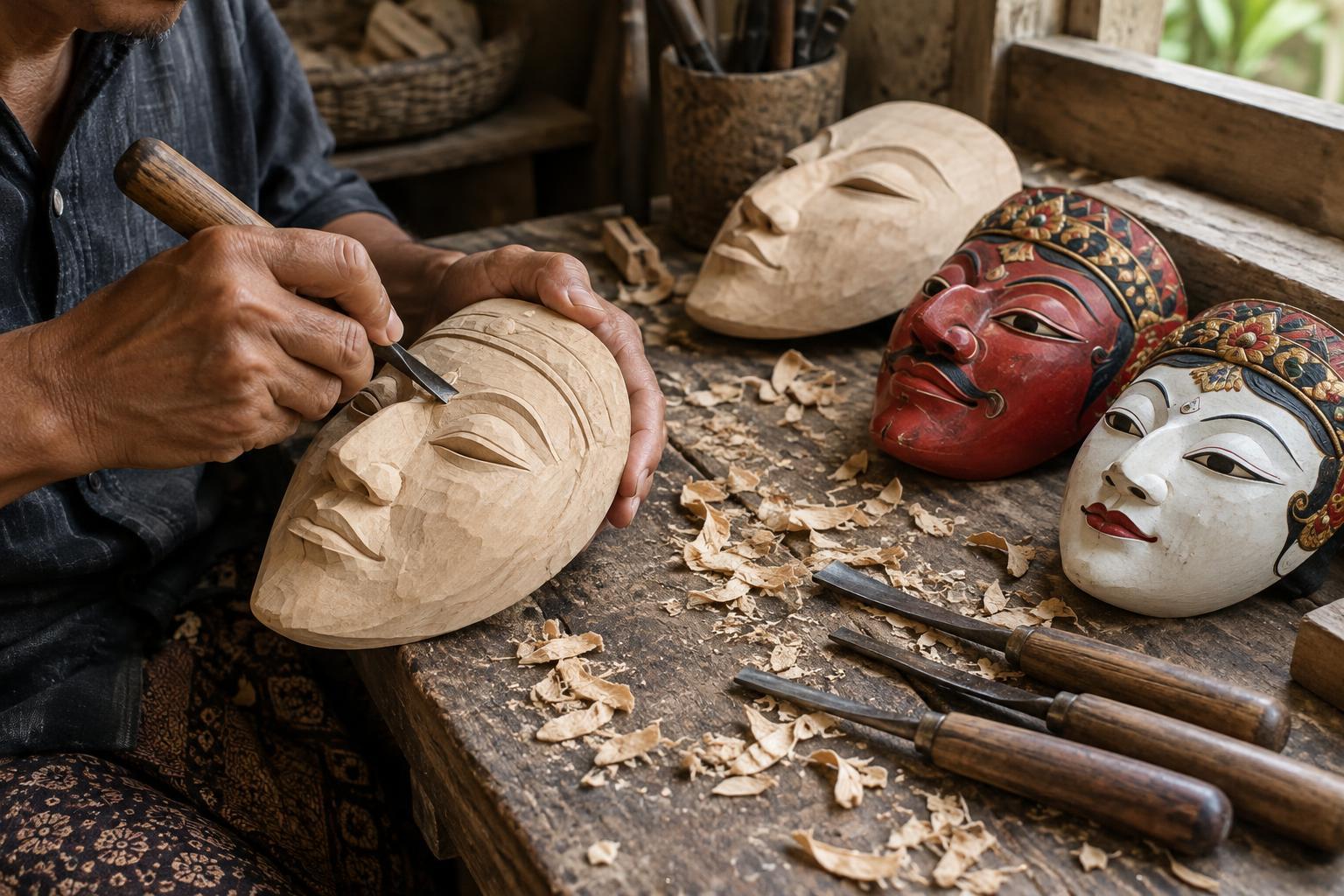
The work starts with a suitable piece of wood. A maker considers its size, grain and condition before laying out the face. The first cuts establish the overall outline and depth; smaller tools then bring forward the brow, cheeks, nose and lips. Each cut affects the expression. A slight change to an eyelid or the angle of a mouth can make a face seem calmer, sharper or more forceful.
The back matters as much as the front. It is hollowed and shaped so the mask can sit against a performer’s face without unnecessary weight. Openings and edges need careful attention for sight and comfort. The maker refines the form gradually rather than treating carving as a single rough stage followed by decoration. Sanding smooths tool marks where a clean painted surface is wanted, though individual makers may leave evidence of handwork in different ways.
Painting an expression
Once the carved surface is ready, the maker can prepare it for paint and build up the character’s colours and details. Broad areas give the face its immediate impact. Finer lines define eyelids, brows, lips and ornament. The painted design works with the carved relief: a line can strengthen an expression, but it cannot entirely replace the shape beneath it.
A finished mask may include additional decorative elements, depending on its character and intended use. Choices of finish also affect how it appears under performance lighting or in daylight. Rather than judging a mask only by how elaborate it looks, notice whether the carving and painting agree. Do the eyes, mouth and lines around them create a coherent face? Can you still read its expression when you step back?
Understanding variation between masks
Cirebon topeng is not one unchanging design reproduced by every workshop. Makers may learn from different teachers, work for different performers or adapt details to a particular order. A mask intended for dancing may call for different practical choices from one made mainly for display. Even when two pieces portray the same character, their proportions, colours and finishing details may differ.
This variation is a reason to ask questions rather than to hunt for a single “correct” example. If you meet a maker, you might ask which character a mask represents, what features distinguish it and whether it was made to be worn. Give the person time to answer in their own terms. The story of a piece includes the decisions made for its use, not just the steps required to produce it.
Visiting a workshop thoughtfully
Watching a mask take shape can make the craft easier to appreciate, especially when you see how much work happens before the first layer of paint. Workshops are working spaces, however, and carving or finishing may require concentration. Ask before entering, photographing people or handling a mask. If a demonstration or conversation is available, follow the maker’s guidance about where to stand and what can be touched.
If you hope to take a mask home, ask whether it is designed for performance, display or another purpose, and how to care for its finish. A handmade piece may vary slightly from another in the same character style; those differences are part of the maker’s work. Whether or not you buy one, leaving with a clearer sense of how carving, painting and performance connect is a meaningful way to experience Cirebon’s mask-making tradition.