Begin with the shape of the monument
Borobudur, in Central Java, was designed to be experienced in motion. From a distance, its stacked terraces form a broad, rising silhouette. Up close, the lower galleries draw your attention to carved walls and narrow passages. Higher up, the layout opens into circular terraces with bell-shaped stupas. That change in space is part of what makes a walk through Borobudur meaningful.
The monument is often explained through three Buddhist realms: the realm of desire, the realm of form and the formless realm. In this reading, the richly decorated lower levels give way to a simpler, more open summit. It is a helpful way to understand the ascent, but it is not a rule that explains every carving or architectural detail. Start by noticing what changes as you move: the amount of imagery, the width of your view and the feeling of the space around you.
Understand what the reliefs are doing
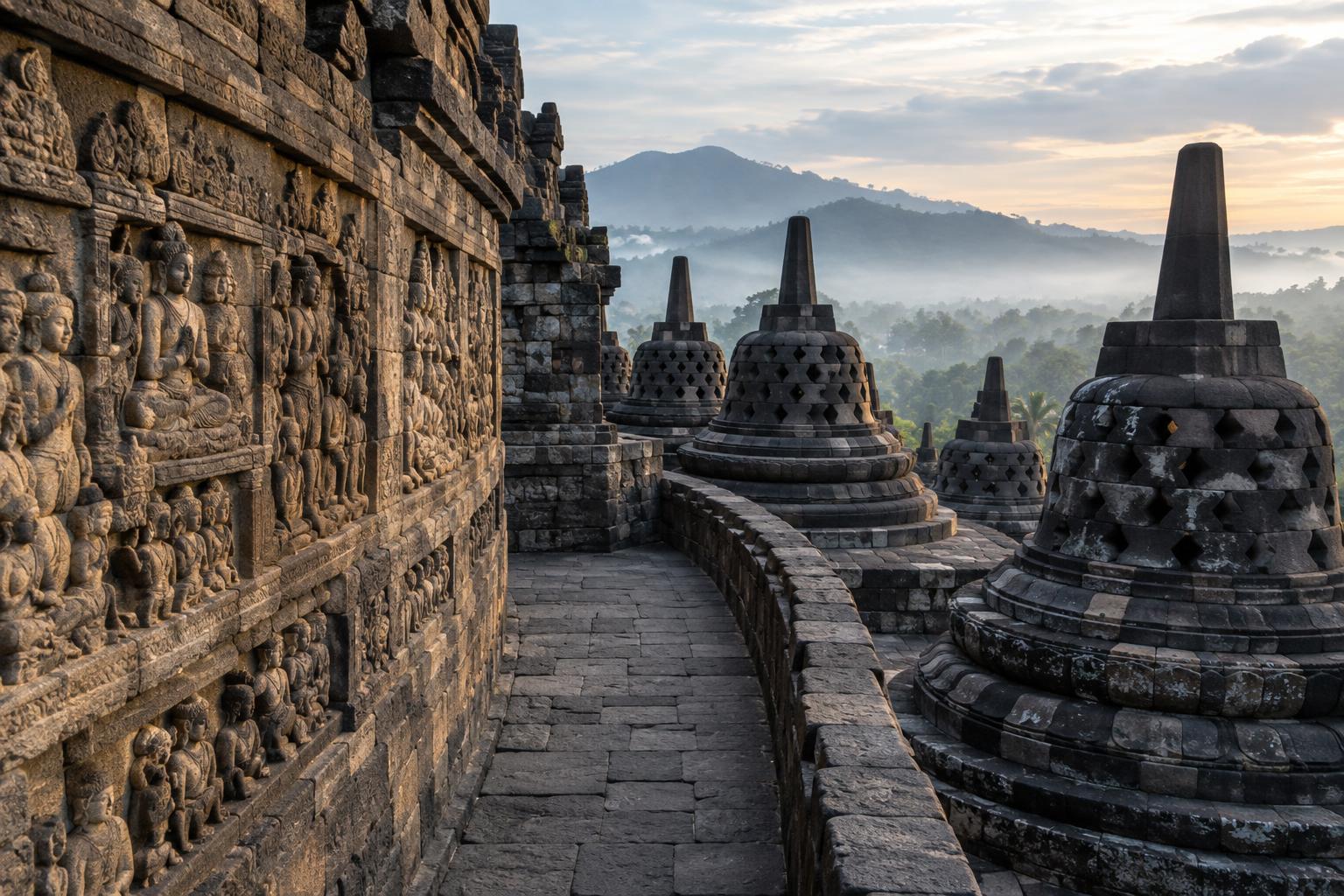
Borobudur’s reliefs are not one continuous story from the base to the top. Different sequences draw on Buddhist teachings and narratives, including accounts associated with the Buddha’s life, stories of earlier lives and a seeker’s spiritual journey. Some panels show recognizable actions, such as travel, conversation or acts of generosity. Others contain details whose meaning is harder to identify without a guide to the particular sequence.
The carvings also offer glimpses of the world imagined by their makers. Look for buildings, boats, trees, clothing and groups of people. These details make the panels rewarding even when you cannot name the characters. At the same time, avoid treating every scene as a literal record of daily life in ancient Java: the artists were illustrating religious stories as well as depicting familiar surroundings.
Follow a gallery without getting lost in the stories
A traditional way to walk around a Buddhist monument is clockwise, keeping the monument on your right. At Borobudur, this approach can help you experience the galleries as a journey rather than a collection of isolated pictures. Follow the visitor route available during your visit, since access to particular levels or passages may vary. You do not need to complete every circuit to appreciate the design.
Choose one stretch of reliefs and slow down. First, look at the whole panel: where are the people, and what seems to be happening? Then notice gestures, objects and changes of setting. Finally, compare it with the next panel to see whether a figure or theme appears to continue. Reading directions and narrative sequences are not identical throughout the monument, so use on-site interpretation or a reliable panel guide if you want to follow a specific story closely.
One useful example to look for in interpretive material is the story of Siddhartha’s path toward Buddhahood, often associated with the Lalitavistara relief sequence. Other sequences present moral and spiritual lessons rather than a single biography. Knowing those broad categories is enough for a first visit; trying to identify every panel can distract from the experience of walking through them.
Read the upper terraces differently
As you reach the circular terraces, the long narrative walls fall away. Bell-shaped stupas surround a larger central stupa, and Buddha images can be seen within some of the perforated structures. The relative openness is a striking contrast to the detailed galleries below. Pause to notice that transition before turning to the distant landscape.
The central stupa is often discussed in relation to the monument’s spiritual symbolism, but its meaning is best approached with care rather than reduced to a single label. The experience of moving from crowded imagery toward a quieter, more spacious setting may be more useful to a first-time visitor than trying to solve every symbolic question.
Make room for both attention and respect
Give yourself time to look at a few panels carefully instead of rushing past hundreds. Soft light can make carved details easier to see, but even in bright conditions you can learn a great deal by stepping back to take in a full scene. If you are visiting with others, choose a meeting point before exploring the galleries so everyone can move at a comfortable pace.
Borobudur is both a heritage site and a Buddhist sacred place. Follow posted visitor guidance, respect barriers and avoid touching the carvings or stupas. A thoughtful visit does not depend on mastering the monument’s entire history. It begins with noticing how architecture, movement and storytelling work together as you climb.