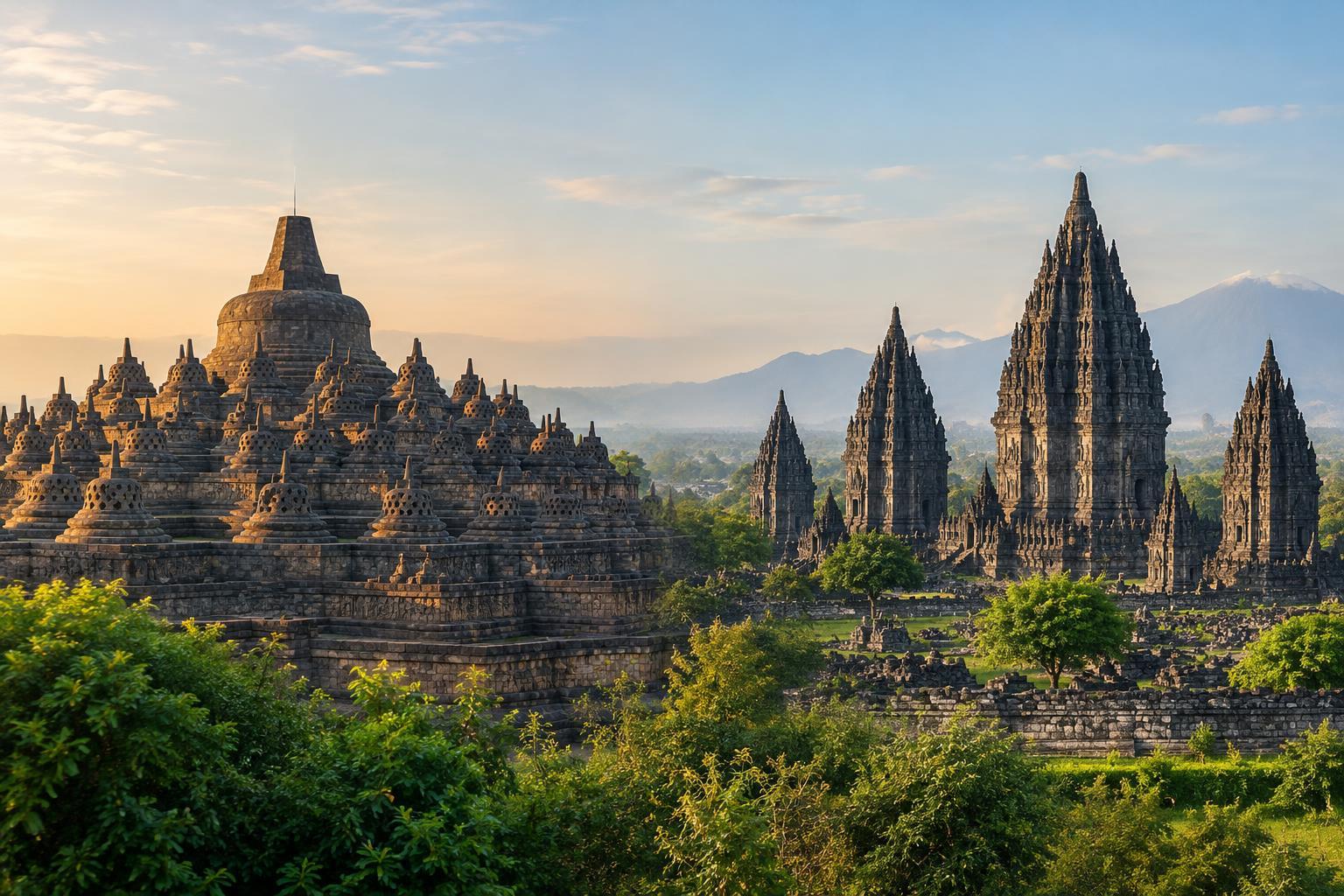
Two monuments, two religious traditions
Borobudur and Prambanan are often paired on a Java itinerary, yet they are not versions of the same kind of temple. Borobudur is a Buddhist monument associated with Mahayana traditions. Prambanan is a Hindu temple complex, with its most prominent sanctuary dedicated to Shiva and major temples also dedicated to Vishnu and Brahma. Knowing this distinction makes their shapes and carvings easier to read.
Neither site can be reduced to a single label, however. Their builders worked within a Javanese landscape shaped by local skills, beliefs, and patterns of patronage. Both used stone architecture and detailed reliefs to express religious ideas. The contrast is most useful as a starting point for looking closely, not as a claim that Buddhist and Hindu life in Java developed in isolation.
Borobudur: a journey across terraces
Borobudur rises as a broad, stepped structure rather than a group of tall, separate temple towers. Visitors move through square galleries lined with carved panels before reaching open circular terraces with bell-shaped stupas. At the top stands a larger central stupa. Seen from a distance, the monument’s wide base and narrowing upper levels give it a strong sense of ascent.
That movement is part of how many visitors understand the site. The galleries reward a slow walk: reliefs depict stories and teachings, while Buddha figures appear throughout the monument. The upper terraces feel markedly different from the enclosed lower passages, with more open views and less narrative detail. It is reasonable to see the route upward as inviting reflection on a Buddhist path, though a brief visit need not follow a prescribed interpretation to be meaningful.
Prambanan: tall sanctuaries and a temple compound
Prambanan presents a different silhouette. Its central temples rise sharply, drawing the eye upward through stacked architectural forms to pointed tops. Rather than circling one great stepped monument, visitors encounter a compound organized around several sanctuaries. The tallest and most prominent is the Shiva temple; the Vishnu and Brahma temples stand nearby. Smaller shrines and the spaces between them are also part of the overall design.
Hindu deities and narrative scenes help identify the complex’s religious focus. Carved panels include episodes from the Ramayana, a story that has also shaped Javanese performing arts. At Prambanan, look at how a relief sequence relates to the temple on which it appears, then step back to see how that temple relates to its neighbors. The site works at both scales: intricate carving close at hand and an imposing arrangement of towers across the compound.
What the designs ask you to notice
A useful comparison is horizontal movement versus vertical emphasis. Borobudur’s terraces encourage a gradual route around and upward through a single monumental form. Prambanan’s soaring temples make individual sanctuaries and their placement within a larger group especially striking. This is not a strict rule for how anyone must experience either site, but it helps explain why walking through them feels so different.
The carvings differ in context as well as subject. At Borobudur, long relief-lined galleries make the act of moving past successive panels central to the visit. At Prambanan, narrative reliefs share attention with deity imagery, temple entrances, and the relationship among the main shrines. At both sites, stone surfaces carry meaning beyond decoration. Even without identifying every figure, you can notice repeated gestures, changes in scene, and the way architecture frames the images.
Exploring both with care
If you visit both, leave enough time to walk rather than only photograph the most recognizable views. Start with the overall shape of each site, then choose a few carvings to examine closely. A site guide or interpretive sign may help you identify scenes, but it is fine to treat unfamiliar details as questions instead of guessing what they represent.
These are heritage places with religious significance, not just scenic backdrops. Follow posted access rules, avoid touching carvings, and be considerate of people who are there to worship or reflect. Borobudur and Prambanan offer a memorable comparison precisely because they are different: one opens out through terraces and stupas, while the other gathers tall Hindu sanctuaries into a dramatic compound. Seeing both on their own terms reveals more than trying to decide which is grander.


