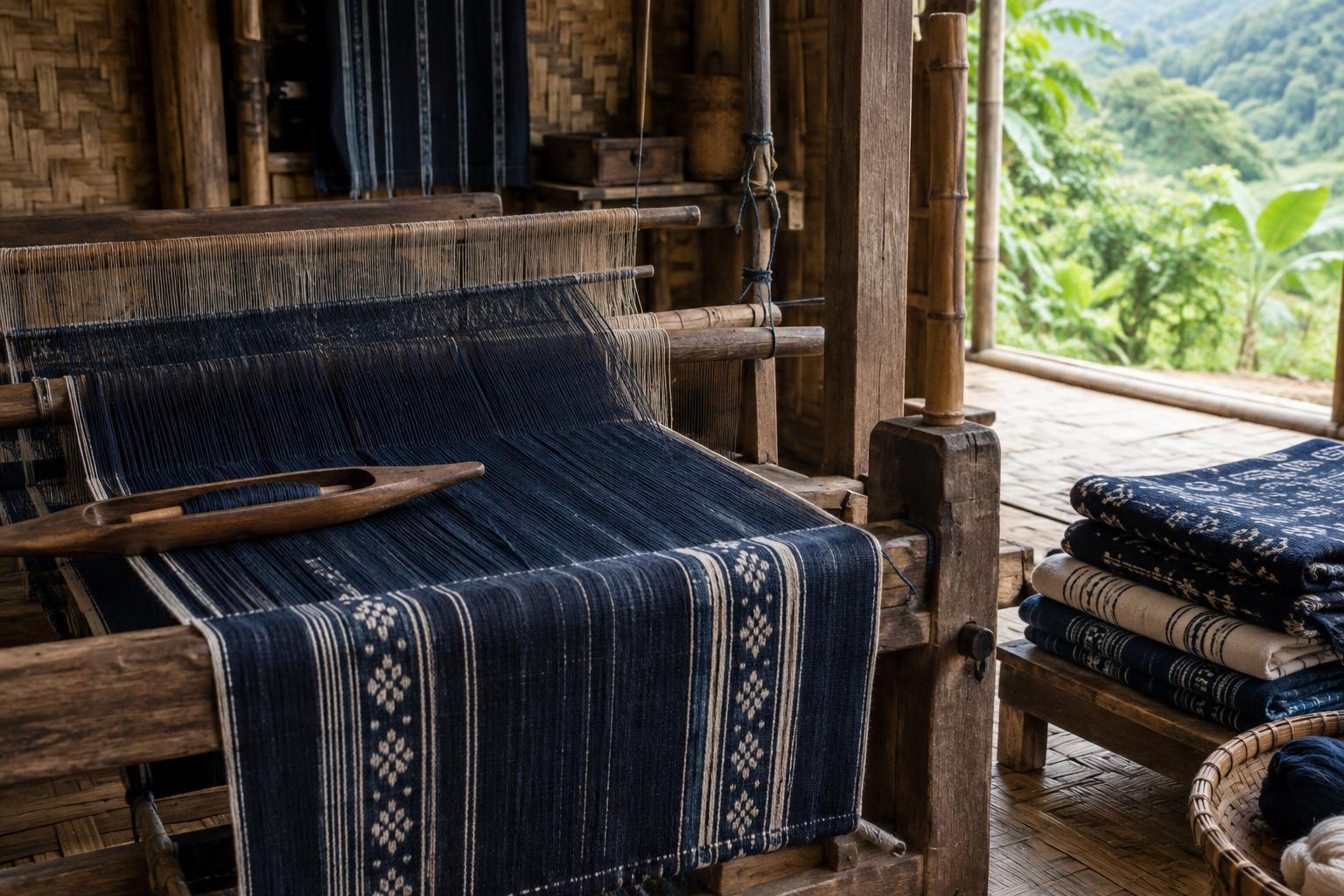
A living tradition at the western end of Java
Baduy weaving is associated with the Baduy communities of Banten province, at the western end of the island of Java. Banten is distinct from West Java province, although the broader phrase “western Java” is often used to describe this part of the island. For a visitor, that distinction matters: it helps place a textile within a particular community and landscape rather than treating it as a generic Javanese souvenir.
Woven cloth can serve everyday and cultural purposes as well as be offered for sale. Not every piece is made for the same use, and practices are not necessarily identical across households or communities. It is worth approaching a textile as an object made by a person, not simply as an example of a fixed “Baduy style.”
Materials and the work of weaving
Baduy textiles are commonly made with cotton yarn. Before buying, ask what a particular piece is made from rather than assuming that every cloth uses the same yarn or dye. The feel and weight of the fabric can offer clues about how you might use it, but touch alone cannot reliably establish its materials or origin.
Weaving builds cloth by passing weft threads across lengthwise warp threads. Choices made while preparing the yarn, arranging the warp and setting the rhythm of the weave affect the finished fabric. A narrow change in spacing or a carefully maintained stripe can be as deliberate as a more conspicuous pattern. Looking closely at these details encourages appreciation of the time and attention involved without requiring a claim that every variation has a symbolic meaning.
Color also deserves a question rather than a guess. Textiles associated with Baduy communities often bring white, dark blue or black to mind, but a piece’s appearance does not, by itself, tell you how its yarn was dyed. If dye methods matter to you, ask the seller what they know and allow room for an honest “I’m not sure.”
Reading patterns without inventing meanings
Stripes, checks and contrasting fields of color can make a woven cloth recognizable at a glance. Yet visual resemblance is not proof that two pieces came from the same maker or were intended for the same purpose. Notice how a pattern is arranged across the whole cloth: whether lines repeat evenly, how borders relate to the center, and how the design changes when the fabric is folded or worn.
It can be tempting to assign a story to every color or motif. Meanings may depend on context, however, and an explanation offered for one textile should not automatically be applied to another. If a maker or knowledgeable seller describes a pattern, listen to the explanation as information about that piece. If no explanation is available, it is more respectful to describe what you can see than to present a guessed symbolism as fact.
The terms Inner Baduy and Outer Baduy refer to communities with different customary boundaries. They are not simple quality labels for textiles. Avoid assuming that a seller’s claim about either term establishes who wove a cloth, how it was made or whether it is appropriate to purchase.
How to buy with care
Start with straightforward questions: Who made this? Is it handwoven? What is the yarn? Is it intended to be worn, used at home or displayed? A seller may not have every answer, especially if they did not obtain the piece directly from its maker. Clear, limited information is more useful than a confident story that cannot be explained.
Check the cloth itself for a use that suits you. Look at its dimensions, edges and overall condition; ask how to care for it before washing or displaying it. Small irregularities can be part of handwork, but you should still feel comfortable with the piece you choose. If comparing prices, consider size, material and workmanship alongside what the seller can tell you about its origin. Respectful buying does not require accepting an unverifiable claim or bargaining in a way that dismisses the maker’s labor.
If visiting an area where Baduy communities live, follow local guidance on access, photography and transactions. Permission to enter one place or photograph one object should not be taken as permission everywhere. You can also buy without visiting a community: choose a seller who explains the textile’s origin as clearly as possible and does not promise access or endorsement they cannot establish. The most thoughtful purchase is one you understand well enough to value and care for after the trip.


